business
Falling Quits, AI Cuts and the Next Retail Cycle
Falling quits, subdued hiring and a rising share of AI-attributed job cuts are creating a potentially frozen U.S. labor market, while retail chains prune physical stores and consumers continue spending. The emerging bifurcation could reshape household consumption and retail strategy.





The “Frozen Middle”: Why Falling Quits and AI Layoffs Could Reshape U.S. Consumer Spending
The U.S. labor market is showing an unusual combination of signals in 2026. Workers are quitting jobs at a relatively subdued rate, hiring has slowed, and employers are simultaneously announcing substantial workforce reductions attributed to artificial intelligence. The result is not a conventional recessionary labor market in which layoffs broadly surge while job openings collapse. Instead, the evidence points toward a more selective adjustment: workers appear less willing to leave jobs voluntarily, while employers are becoming more selective about which jobs they retain, automate or eliminate.
This creates what can be described as a “frozen middle” in the labor market. The term is an analytical description rather than an official statistical category. It captures a labor market in which employment remains comparatively stable for many incumbent workers, but the normal mechanisms that allow workers to move from weaker jobs to better ones quitting, hiring and occupational switching have become less fluid.
At the same time, the disruption is highly uneven. Technology and other white collar service industries account for a disproportionate share of AI linked job cuts, while physical retail businesses are responding to a different problem: individual stores and locations that no longer generate acceptable returns. The simultaneous closure of physical footprints and reduction of white collar headcount could have an important consequence for consumer companies. Retail sales can remain resilient in the short term even as the labor market underneath them becomes less mobile and increasingly polarized.
JOLTS Shows a Labor Market With Less Voluntary Movement
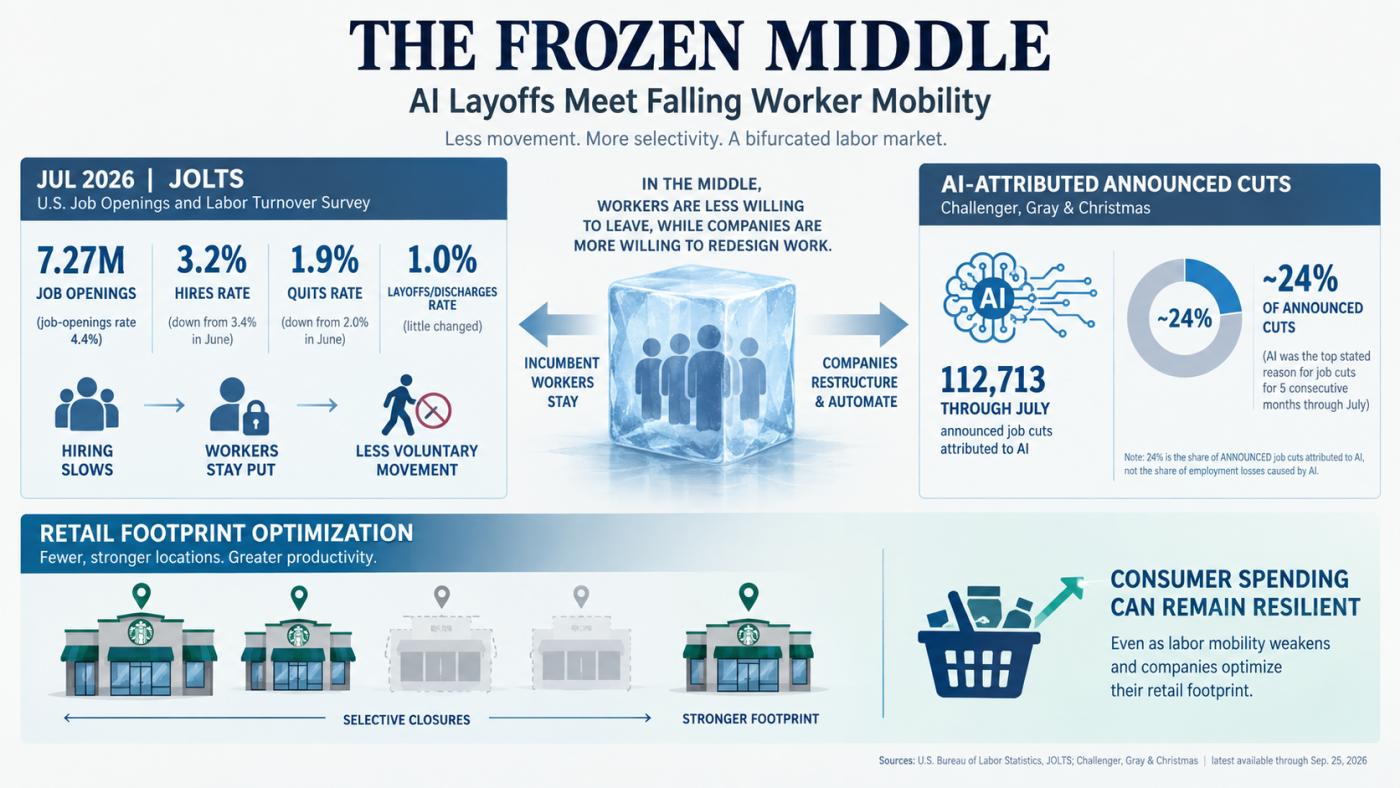
The latest available Bureau of Labor Statistics Job Openings and Labor Turnover Survey, covering July 2026, provides an important starting point. The BLS reported approximately 7.27 million job openings, a job openings rate of 4.4%, a hires rate of 3.2%, and a quits rate of 1.9%. The agency described the number and rate of quits as “little changed” during July, with approximately 3.1 million workers quitting their jobs.
The significance is clearer when quits are considered alongside hiring. The July hires rate was 3.2%, down from 3.4% in June, while the quits rate declined from 2.0% to 1.9%. The BLS also reported that hires fell by 278,000 in July to approximately 5.05 million. In professional and business services, hires declined by 188,000 during the month. These movements do not constitute evidence of a labor market collapse, but they are consistent with a market in which both employers and employees are becoming more cautious.
The Bureau of Labor Statistics JOLTS data are particularly useful because quits measure voluntary separations initiated by employees. A high quits rate generally accompanies a labor market in which workers feel sufficiently confident about alternative employment to leave their existing jobs. A lower rate therefore does not necessarily mean workers are satisfied with their jobs. It can also mean that the perceived cost of moving has increased.
That distinction matters in 2026. If a worker believes that another employer might also be reducing headcount, the incentive to surrender an existing paycheck becomes weaker. A worker who might previously have resigned for a modest salary increase may instead remain in place because job security has become more valuable than mobility.
AI Is Concentrated Where Labor Costs Are High and Work Is More Digitizable
Challenger, Gray & Christmas provides a second piece of the puzzle. Its job cut announcement data are not equivalent to BLS payroll data: Challenger tracks announced planned cuts, while BLS measures actual employment and labor turnover. Nevertheless, the two datasets illuminate different parts of the same adjustment process.
Through July, Challenger reported that employers had announced 112,713 job cuts attributed to artificial intelligence, approximately 24% of all announced cuts. In July alone, AI was cited in 10,970 announced cuts, or 33% of the month's total. Challenger said AI had been the leading stated reason for job cuts for five consecutive months through July.
The concentration by industry is striking. Technology companies had announced approximately 149,023 cuts through July, according to Challenger, substantially more than any other industry. Transportation, health care/products and services followed at considerably lower levels. Challenger also noted that technology cuts were up 67% from the comparable period, even while many other industries were reporting fewer reductions.
Challenger's Andy Challenger described the technology labor market as undergoing “incredible disruption with AI,” while noting that the technology is changing the nature of work and making some positions, particularly entry level engineering roles, more difficult to obtain. The important point is not that AI is eliminating an entire occupational class. Rather, employers appear to be using AI alongside conventional cost control and restructuring programs to change the number, composition and seniority of workers they need.
This distinction becomes important when interpreting the roughly quarter share attributed to AI. Challenger's figure represents the stated reason attached to announced job cuts, not a measurement showing that one quarter of all U.S. employment has become technologically redundant. Companies can simultaneously reduce staff because of AI, restructuring, changing demand, mergers or cost pressures. In some announcements, these factors overlap.
Why the Combination Can Produce a “Frozen Middle”
Put the JOLTS and Challenger evidence together and a distinctive mechanism emerges. Companies are cutting some jobs, especially in technology and services, while the remaining workforce is becoming less willing to move voluntarily. That can produce a labor market with substantial internal friction even when the aggregate unemployment rate remains relatively moderate.
Consider the incentives facing an incumbent worker. Leaving a job means surrendering a known source of income in exchange for an uncertain opportunity. If job advertisements remain plentiful but employers are taking longer to hire, requiring more skills or quietly eliminating positions after posting them, the expected benefit from quitting declines. The worker therefore stays.
At the employer level, the calculation is almost the reverse. Instead of replacing every departing employee, companies can choose to leave some positions vacant, redistribute work, automate selected tasks or redesign entire teams. A falling quits rate can consequently reduce natural employee turnover at exactly the moment when companies want to change the composition of their workforces.
The result is a labor market in which fewer workers leave voluntarily while companies make more deliberate decisions about which roles disappear. This can slow the reallocation of labor even if aggregate employment does not fall dramatically.
It also helps explain why the conventional unemployment rate can understate the economic anxiety associated with a cooling labor market. Someone who remains employed but abandons plans to change careers, negotiate a raise or move to a higher paying company is still counted as employed. Yet the person's economic behavior may already have changed.
Starbucks Illustrates the Physical-Retail Side of the Adjustment
The other half of the story is playing out in physical retail. On September 24, 2026, Starbucks announced that it would close approximately 250 North American coffeehouses, representing about 1% of its more than 18,000 North American locations. The company said it had identified stores where it did not believe it could consistently deliver the desired customer and employee experience or where it saw no path to acceptable financial performance.
Starbucks chief operating officer Mike Grams wrote that the company had “carefully reviewed our North America coffeehouse portfolio” before identifying locations for closure. The company characterized the move as part of its broader “Back to Starbucks” strategy rather than simply a response to a nationwide collapse in coffee demand.
The Starbucks announcement is significant because it demonstrates that labor market adjustment is not occurring only through office layoffs. Physical businesses are also pruning their networks. A store can be removed because of rent, traffic, labor economics, local competition, productivity or a combination of factors even when the overall consumer category remains healthy.
That is a very different form of adjustment from an AI driven reduction in software engineers or administrative staff. Yet both are manifestations of the same corporate priority: extracting more output from a smaller or more productive operating footprint.
Retail Employment Is Not Collapsing But Hiring Is Becoming More Surgical
The broader retail employment data reinforce this distinction. BLS employment data show that retail trade employment was approximately 15.49 million in August 2026, with employment essentially flat during the month and up modestly over the year. At the same time, leisure and hospitality added 62,000 jobs in August, while information employment declined by 23,000 and financial activities fell by 11,000.
That pattern is important. The labor market bifurcation is not simply “AI destroys jobs while retail creates them.” Retail employment can remain relatively stable while individual stores close because other retailers, locations or formats continue to hire. A national retail chain can therefore reduce its physical footprint without causing a proportional collapse in retail employment.
Challenger's September 23 holiday hiring analysis provides another clue. The firm estimated that retailers would add approximately 450,000 seasonal workers in the fourth quarter of 2026, below the 461,500 added in Q4 2025. It noted that retailers were increasingly relying on existing employees and on-demand labor rather than making large early seasonal commitments.
Andy Challenger said that “consumers are stretched but they are still showing up,” pointing to August retail sales and back-to-school spending as evidence of continued demand. But he also noted that retailers were leaning on automation, existing associates and on-demand pools before committing to new seasonal workers.
The Challenger holiday-hiring analysis therefore suggests a subtle shift in the retail labor model: companies can maintain sales capacity without maintaining the same level of traditional employment growth.
Consumer Spending Could Stay Stronger Than Labor Mobility
This creates an unusual potential trajectory for consumer spending. The latest Census Bureau data show that U.S. retail and food services sales reached approximately $773.9 billion in August 2026, up 1.2% from July and 6.0% from August 2025. Those figures are nominal and are not adjusted for price changes, so the increase should not be interpreted as an equivalent increase in real purchasing volume.
Nevertheless, the data demonstrate that consumers had not entered a broad spending retreat by August. The question is what happens if the “frozen middle” persists.
One possibility is that consumer spending initially remains surprisingly resilient. Workers who retain their jobs continue receiving paychecks, while people who might otherwise have changed jobs remain employed. Retailers can therefore continue selling to a population whose aggregate employment income has not collapsed.
But the composition of spending could change. Workers who feel less secure may postpone discretionary purchases, favor promotions, reduce large ticket commitments and build cash buffers. That could leave mass market necessities and value oriented retailers relatively better positioned than businesses dependent on discretionary spending, premium experiences or frequent impulse purchases.
The July BEA data already provide a useful warning against treating retail sales as a perfect proxy for household financial confidence. Personal consumption expenditures increased 0.2% in July, but the increase was driven by services while spending on goods declined. Disposable personal income increased 0.5%, while the personal saving rate was 3.0%.
In other words, households can continue spending even while changing what they spend on. That distinction may become increasingly important for retail chains as labor market uncertainty persists.
The Retail Footprint May Become More Important Than the Retail Workforce
The Starbucks example points toward another underappreciated consequence. If consumer demand becomes more uneven geographically, retailers may discover that their optimal response is not to cut employees everywhere but to eliminate low-productivity locations.
This creates a potential feedback loop. A store closure reduces local employment and removes a physical consumption point. At the same time, the surviving locations may receive additional customers and become more productive. Digital ordering, delivery, automation and centralized fulfillment can allow a company to serve demand with fewer physical sites.
For investors and analysts examining consumer companies, the important metric may therefore shift from headline store counts toward sales productivity per location, labor productivity, employee turnover and the quality of the remaining footprint.
A company closing stores is not necessarily experiencing collapsing demand, just as a technology company reducing headcount is not necessarily experiencing collapsing revenue. In both cases, management may be reallocating resources toward fewer, more productive units.
What the “Frozen Middle” Could Mean for Retailers Through the Holiday Season
The holiday period will provide an important test. Retailers are entering the season with evidence of resilient sales but comparatively cautious hiring. If consumers continue spending, companies may discover that they can meet demand with smaller permanent workforces, flexible seasonal labor and greater automation.
If spending weakens, however, the same labor market structure could amplify the slowdown. Workers who are already reluctant to quit may become even more defensive, while unemployed white collar workers facing AI related displacement could reduce discretionary consumption. At the same time, retailers may respond by closing marginal stores, limiting hiring and concentrating investment on their strongest locations.
That would create an unusual asymmetry: employment could remain relatively stable among incumbent workers while economic mobility deteriorates at the margins. Retail sales could therefore hold up longer than measures of job switching, hiring or employee confidence would suggest.
The evidence available as of September 25 does not establish that AI is causing a generalized collapse in U.S. employment, nor does it prove that a permanent “frozen middle” has emerged. BLS JOLTS data show subdued quits and hiring, while Challenger's announced-cut data show an unusually large share of layoffs attributed to AI. These are different datasets with different methodologies and should not be mechanically combined.
But taken together, they identify a labor market mechanism worth watching: workers are becoming more reluctant to move at the same time that companies are becoming more willing to redesign work. The result may be less visible in the unemployment rate than in job mobility, wage bargaining, entry level opportunities and the geographic restructuring of physical retail.
For consumer companies, that distinction could prove consequential. The next phase of the cycle may not be defined by whether Americans stop spending altogether. It may instead be defined by whether increasingly cautious workers continue spending steadily while companies simultaneously reduce stores, automate tasks and hire fewer people to serve the same demand.