business
The Silent Rise of Corporate Bond Financing
Examines how India's growing corporate bond market is quietly becoming a financing engine for manufacturing sectors supported by PLI schemes, highlighting structural financial deepening.





While equity markets capture daily headlines with their record-breaking rallies, a quieter but arguably more significant transformation is unfolding in India's financial system. The corporate bond market, long overshadowed by its equity counterpart, is steadily emerging as a crucial engine for financing the country's manufacturing ambitions, particularly for sectors championed by the Production Linked Incentive (PLI) schemes. Far from being just an alternative to bank credit, the deepening of this market represents a fundamental structural shift, providing the long-term, patient capital essential for building a world-class industrial base.
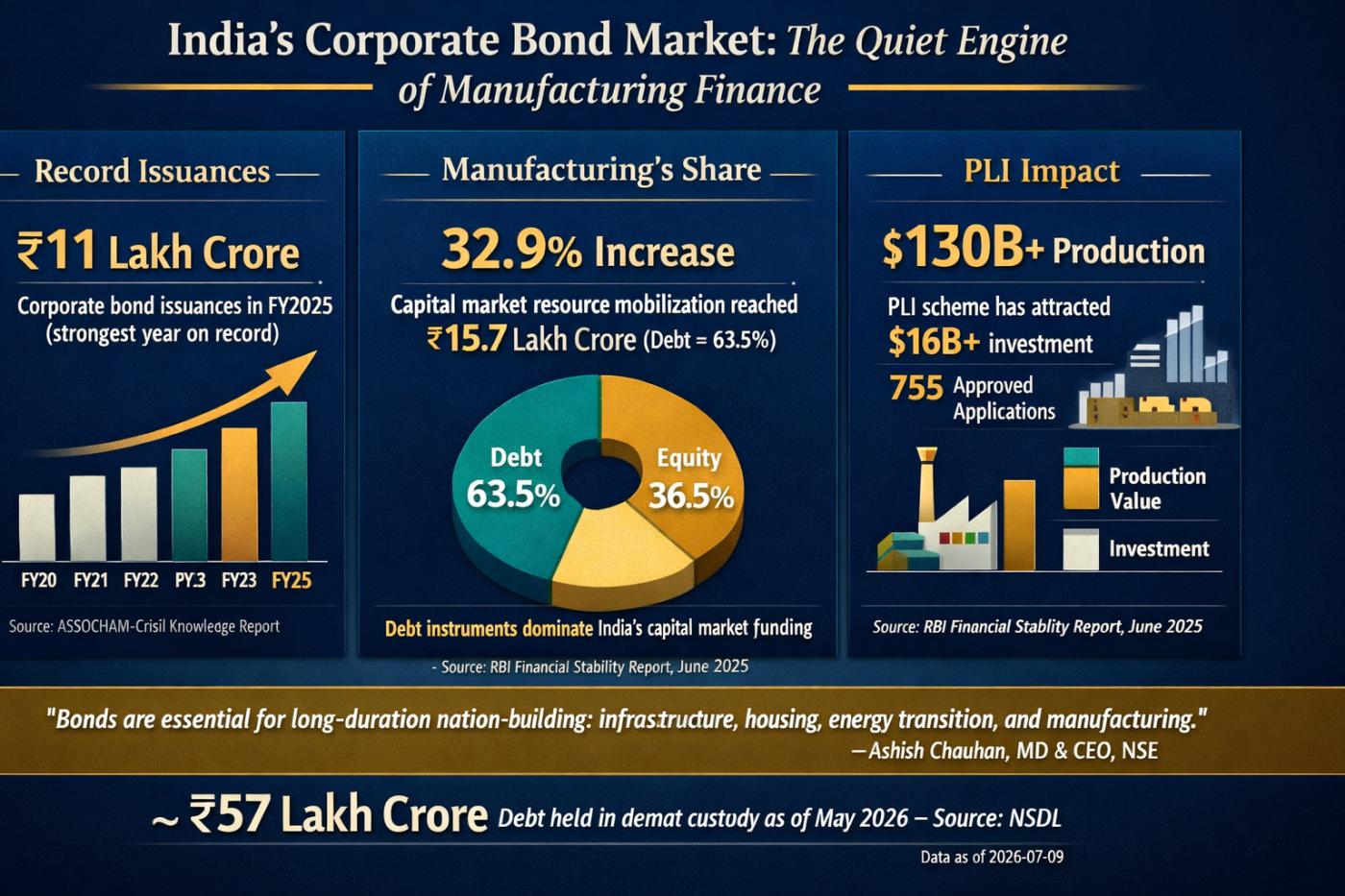
This is not about daily market movements but about a profound change in how India funds its future. Data from the Reserve Bank of India's (RBI) Financial Stability Report (FSR) for June 2025 underscores this pivot. The report highlights a 32.9% increase in resource mobilization through capital markets, reaching Rs 15.7 lakh crore by March 2025. Crucially, debt instruments accounted for a dominant 63.5% of this total . This shift is a clear indicator that India Inc. is increasingly looking beyond traditional bank loans to fuel its growth, a trend that has profound implications for capital-intensive sectors like manufacturing.
The PLI Imperative and the Search for Scale
The government's Production Linked Incentive (PLI) scheme, launched in 2020, aims to transform India into a global manufacturing hub by incentivizing production in 14 key sectors, including electronics, automobiles, pharmaceuticals, and renewable energy. With a total outlay of $33 billion, the scheme has already approved 755 applications, attracted investments of over $16 billion, and facilitated production worth more than $130 billion . This ambitious program has created a significant and growing demand for capital.
As companies scale up production to meet PLI targets, they require substantial investment in new plants, machinery, and technology. The funding needs of these projects often with long gestation periods are ill-suited to the typical short-to-medium tenor of bank loans. Here, the corporate bond market steps in. As NSE Managing Director and CEO Ashish Chauhan recently articulated, "Banks are good for working capital and shorter-tenor credit. Bonds are essential for long-duration nation-building: infrastructure, housing, energy transition, and manufacturing." He further stressed that deepening the bond market has moved from a policy preference to a "national financing necessity" .
Record Issuances and Deepening Liquidity
The corporate bond market has responded with remarkable vigour. The ASSOCHAM-Crisil Knowledge Report notes that the market has been the most dynamic component of India's debt market, rising approximately 13% year-on-year to ~Rs 53.6 lakh crore in March 2025. In fact, fiscal 2025 was the strongest year on record, with companies raising ~Rs 11 lakh crore through corporate bonds . This growth is supported by a broadening investor base, including mutual funds, insurance companies, and pension funds, which are increasingly seeking the attractive yields offered by corporate debt.
While the market is currently dominated by highly-rated issuers (AAA and AA), this is a natural starting point. The sheer volume of funds being raised is creating a virtuous cycle. More issuances lead to greater secondary market activity, which in turn improves liquidity and price discovery. SEBI Chairman Tuhin Kanta Pandey has highlighted that the regulator is actively working to deepen this liquidity, with recent Union Budget proposals including a market-making framework for corporate bonds and derivatives on corporate bond indices. As Pandey noted, these measures will "help improve price discovery, narrow bid-ask spreads and enhance secondary market liquidity" .
Credit Enhancement: Bridging the Rating Gap
One of the perennial challenges for the corporate bond market has been its concentration in top-rated paper, effectively locking out smaller but promising manufacturing firms. As M. Nagaraju, Secretary of the Department of Financial Services, pointed out, "In India, 90-95 percent of bond issuances are from companies that are AA or above rated. The middle tier of bond market doesn’t exist in India." This 'missing middle' is a significant hurdle for broad-based manufacturing growth .
However, this is precisely where innovation is beginning to take root. Credit enhancement mechanisms, such as guarantees from institutions like the National Credit Guarantee Trustee Company (NCGTC) or partial credit guarantees, are being explored and implemented. These tools can help improve the credit rating of a bond issue, making it viable for institutional investors who are mandated to invest only in high-rated paper. By mitigating risk, these mechanisms can channel funds to smaller but critical manufacturing units, enabling them to participate in the PLI scheme and scale up operations. This is a crucial frontier for the market's evolution, aiming to make corporate bonds a "mainstream funding option," as SEBI Chairman Pandey envisions .
Institutional Participation: The Silent Engine
The narrative of a quiet revolution is also driven by the changing composition of investors. Data from the National Securities Depository Limited (NSDL) reveals the immense scale of institutional holding. As of May 2026, the value of debt and bonds held in demat custody stood at over Rs 57 lakh crore, underscoring the deep appetite from institutional players for fixed-income securities . This is not speculative capital; it is the steady, long-term investment from insurance companies, provident funds, and mutual funds. This institutional participation provides the market with a stable base, allowing companies to issue longer-tenor bonds that perfectly match their investment horizons for manufacturing projects.
Furthermore, the inclusion of Indian government bonds in global indices has had a positive spillover effect. It has enhanced overall confidence in the Indian debt market, attracting foreign portfolio investors (FPIs) to the ecosystem. As Jiju Vidyadharan, Senior Director at Crisil Intelligence, notes, "The inclusion of Indian government bonds in global indices reflects strong trust in the domestic capital market, further strengthening India's position in the global economic landscape" . This increased foreign participation adds to the depth and liquidity of the entire debt market, benefiting corporate issuers as well.
A Structural Shift in Capital Formation
The evidence points to a clear and irreversible trend. As the RBI's FSR indicates, bank lending to the industrial sector slowed to just 6.9% in FY25, while corporate bond issuances soared . This is not a temporary blip but a structural shift. Companies are discovering that the corporate bond market offers a more efficient, flexible, and cost-effective way to raise capital, especially for large-scale, long-term projects.
This development is perfectly aligned with the goals of the PLI scheme. By providing a viable funding avenue for manufacturing, the bond market is directly contributing to the creation of a robust industrial ecosystem. It is helping to finance the new factories, the advanced machinery, and the R&D centers that will power India's next phase of growth. The success of companies like Dixon Technologies, a leading electronics manufacturer, which has capitalized on the PLI scheme to achieve high growth, is a testament to what is possible when policy and financing align .
In conclusion, while the equity markets may provide the drama and the daily thrill, it is the steady, measured, and increasingly deep corporate bond market that is quietly building the financial backbone for India's manufacturing resurgence. It is the unsung hero of the PLI story, providing the patient capital needed to build a manufacturing sector that is not just large, but globally competitive. The quiet engine of India's manufacturing financing is, in fact, humming louder than ever before.