business
Student Loans Are Reshaping More Than Borrower Credit
The resumption of federal student-loan reporting is creating effects beyond borrowers themselves. New York Fed, CFPB, Department of Education and Federal Reserve research shows how credit-score deterioration can affect mortgage and auto access, household liquidity and the personal-credit financing that many startups depend on.





The return of federal student-loan collections is easy to describe as a problem affecting borrowers who have fallen behind. That framing misses the more consequential economic question: what happens when a repayment shock is transmitted through the credit system to people and businesses that are not themselves student lenders or borrowers?
The answer emerging from the Federal Reserve Bank of New York's Consumer Credit Panel, Consumer Financial Protection Bureau research, Department of Education portfolio data and Federal Reserve household and small-business surveys is more nuanced than either a claim of widespread financial contagion or a claim that student-loan defaults are economically isolated. The documented evidence shows a substantial deterioration in credit standing for millions of borrowers, including many who had not previously been seriously delinquent. It also shows that credit scores matter for access to mortgages, auto loans and business financing. What remains less firmly established is the size of the second-order effect: exactly how many home purchases, vehicle purchases or business launches are being prevented because a student-loan delinquency has damaged an individual's credit profile.
That distinction matters. The available evidence supports a transmission mechanism from student-loan repayment problems to broader credit access, but it does not justify attributing every recent weakness in housing, autos or entrepreneurship to student debt.
The reporting shock was larger than a normal delinquency cycle
Federal student-loan payments resumed in October 2023 after a 43-month pandemic suspension. A subsequent 12-month on-ramp prevented missed payments from being reported to the credit bureaus, delaying the visible effect on household credit until early 2025. The New York Fed's Consumer Credit Panel, based on anonymized Equifax credit records, captured that transition unusually clearly.
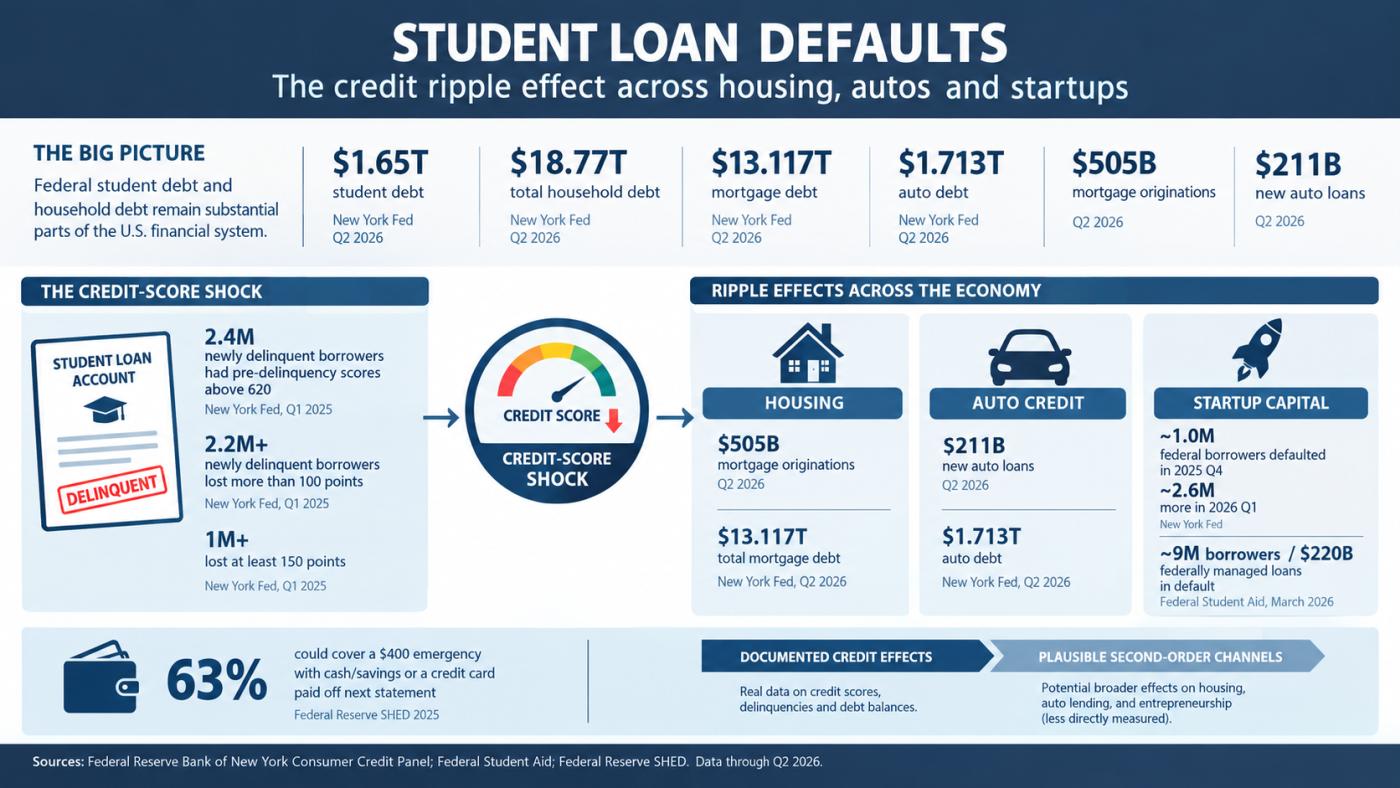
In May 2025, Andrew F. Haughwout, Donghoon Lee, Daniel Mangrum, Joelle Scally and Wilbert van der Klaauw of the New York Fed reported that more than 2.4 million borrowers who became newly delinquent had credit scores above 620 before the delinquency appeared. Those borrowers were not necessarily marginal applicants: many would previously have qualified for auto loans, mortgages or credit cards. More than 2.2 million newly delinquent borrowers experienced credit-score declines of more than 100 points, while more than one million saw declines of at least 150 points. The researchers wrote that these borrowers would face "steeper borrowing costs or denial for new credit." The underlying New York Fed analysis is particularly important because it identifies the borrowers whose credit-market status changed, rather than simply counting the number of delinquent loans.
The subsequent deterioration was not confined to borrowers who had already been struggling before the pandemic. In May 2026, Zara Jacob, Donghoon Lee, Daniel Mangrum, Joelle W. Scally and Wilbert van der Klaauw found that roughly 1 million federal borrowers entered default during the fourth quarter of 2025 and another 2.6 million during the first quarter of 2026. Importantly, more than three-quarters of these recent defaulters had either been current on their loans in 2019 or did not have a payment due at that time. Nearly 30 percent had been current and making payments before the pandemic.
This is a crucial second-order feature. The repayment shock is not simply cleaning up a pre-existing pool of chronically distressed borrowers. A significant share of the newly defaulted population had previously been outside the obvious high-risk group.
By mid-2026, the federal portfolio was still enormous
Department of Education portfolio data show that the federal government continues to oversee a student-loan system measured in the trillions of dollars, with millions of borrowers distributed across repayment, deferment, forbearance, delinquency and default categories. The Department's Federal Student Aid data center provides the portfolio by loan status, repayment plan, age, debt size and geography, with June 2026 data available.
The New York Fed's Q2 2026 Household Debt and Credit Report put total student debt appearing on consumer credit reports at approximately $1.65 trillion. That was down slightly from the previous quarter but still represented one of the largest categories of household liabilities. Total U.S. household debt was $18.77 trillion at the end of June, including $13.12 trillion in mortgages, $1.71 trillion in auto debt and $1.26 trillion in credit-card debt.
The student-loan figures therefore need to be understood as part of a much larger balance sheet. A household does not carry its student loan in isolation: the same credit file may determine whether it can obtain a mortgage, finance a vehicle, refinance existing debt or obtain a business credit card.
The first transmission channel is the credit score itself
Credit reporting turns a missed student-loan payment into information that can be consumed by lenders across the economy. The CFPB states that payment history, outstanding debt, account history and other credit-report information feed credit-scoring models, and that lenders use scores in decisions involving mortgages, auto loans, credit cards and other credit products.
The CFPB has also repeatedly emphasized the importance of accurate student-loan servicing and credit reporting. Its 2025 consumer-response data recorded approximately 23,700 student-loan complaints, with "Dealing with your lender or servicer" the most common identified problem. That does not prove that servicing failures caused the broader deterioration in credit scores, but it demonstrates that the administrative side of repayment is itself a significant part of the market.
The distinction between a borrower becoming less able to pay and becoming less creditworthy is particularly important. A borrower might still have sufficient income to make a future mortgage or auto payment but suddenly score much worse because a student-loan delinquency has appeared on the credit file. The credit market therefore responds not only to current cash flow but also to the newly observed probability of future repayment.
Housing is where the second-order effect can become unusually large
Mortgage underwriting makes credit-score changes economically significant because a mortgage is a large, long-duration commitment. A relatively small change in the probability of approval, the interest rate offered or the maximum debt-to-income ratio can determine whether a household can purchase a home at all.
The CFPB explicitly notes that credit scores and credit reports influence whether an applicant can obtain a mortgage and the rate offered. The New York Fed's earlier research on student debt provides historical evidence for the mechanism. Its Consumer Credit Panel research found that younger borrowers with substantial student debt were less likely to obtain mortgages, and researchers identified both demand and credit-supply channels, including tighter debt-to-income constraints and lower credit scores among borrowers with student debt.
That historical evidence should not be presented as proof that today's student-loan reporting shock has caused a measurable nationwide decline in mortgage approvals. It has not. Mortgage originations remain substantial: the New York Fed recorded approximately $505 billion in newly originated mortgages in Q2 2026. The median credit quality of mortgage borrowers and the overall state of the housing market are influenced by many factors, including home prices, mortgage rates, income, down-payment capacity and lender underwriting.
What can reasonably be inferred is narrower but important. If millions of borrowers move from prime or near-prime credit categories into materially weaker categories, some applicants who would otherwise qualify for mortgage financing will face either higher borrowing costs, lower allowable loan amounts or rejection. The effect is likely to be concentrated rather than systemic: first-time buyers and households with limited cash reserves have less room to absorb a higher rate or larger down payment.
The New York Fed itself cautioned in 2026 against treating the student-loan episode as broad credit-market contagion. Its researchers found that borrowers who recently defaulted had unusually high delinquency rates on other debts, but these borrowers represented only about 2 percent of the credit population. Balances held by delinquent or defaulted student-loan borrowers represented roughly 1 percent of mortgage balances, 2 percent of credit-card balances and 2.7 percent of auto-loan balances.
Thus the evidence points toward a distributional housing effect, not a national mortgage-market crisis. The relevant question is not whether student-loan defaults will destabilize mortgage lenders. The data do not suggest that. The more plausible effect is that a subset of potential buyers becomes less able to cross the underwriting threshold.
Auto lending offers a similar but faster transmission channel
Auto credit is especially sensitive to credit-score changes because vehicle financing is commonly underwritten using standardized risk tiers. The New York Fed reported $211 billion in new auto loans appearing on credit reports in Q2 2026, while outstanding auto debt reached approximately $1.71 trillion.
Again, there is no evidence that the student-loan reporting restart caused the national auto market to contract. In fact, auto originations were substantial. But the credit-score mechanism is straightforward: a borrower moving from a prime score into a subprime or near-subprime category may face a higher interest rate, a larger required down payment, a smaller approved loan or no approval from a particular lender.
The New York Fed's 2026 analysis found that nearly 40 percent of newly defaulted borrowers who had an auto loan were themselves delinquent on that debt by Q1 2026. That is not evidence that student-loan default caused those auto delinquencies; the researchers explicitly noted that these borrowers had broader financial difficulties. It does, however, show that the households most exposed to student-loan default can also be exposed to stress in other credit markets.
The second-order effect therefore works in both directions. A weak household balance sheet can cause a student-loan default and an auto delinquency, while the resulting credit damage can subsequently make refinancing or replacing a vehicle more expensive. The credit report becomes a mechanism through which several initially separate financial problems reinforce one another.
The overlooked channel is entrepreneurship
The connection between student-loan credit damage and entrepreneurship is less directly measured but potentially more economically important than it first appears.
Young and early-stage businesses frequently lack the operating history, collateral and independent business credit required for conventional lending. The Federal Reserve's Small Business Credit Survey has documented the resulting dependence on owners' personal financial resources. In its 2024 report on startup firms, based on the 2023 survey, startup businesses were more likely than older firms to receive funds from their owners. Startup employer firms were also much more likely to seek financing, yet only 43 percent of applicants were fully approved, compared with 54 percent of older employer firms.
The survey also found that startup nonemployers were particularly likely to use personal financing channels. Among startup firms, personal loans were more prominent than among older firms, while personal funds were frequently used to deal with financial challenges. The survey's credit-risk framework itself recognizes that a firm's relevant credit measure may be a personal credit score when that is the score used to obtain financing.
This matters because the boundary between household credit and business credit is porous at the startup stage. A founder does not necessarily need a poor business credit score to be denied financing; a damaged personal score can be enough when the lender evaluates the owner as the primary source of repayment.
The Federal Reserve's March 2025 review of small-business credit makes the broader point directly: small-business owners may finance their enterprises with personal savings, personal loans, credit cards and home-equity loans. More than half of employer firms surveyed in the 2023 Small Business Credit Survey regularly used business credit cards, while business loans and lines of credit were also common.
That creates a plausible third-order effect. A student-loan delinquency can reduce an individual's personal credit score; the weaker score can reduce access to personal credit; and reduced personal credit capacity can lower the amount of capital available to launch or expand a small business. The result could be fewer marginal business launches, slower expansion or greater reliance on more expensive forms of finance.
But this is an inference, not a measured national estimate. Neither the New York Fed's student-loan research nor the Federal Reserve's small-business surveys currently establish that a particular number of startups were prevented because their founders' student-loan credit scores deteriorated. What the evidence establishes is that the two systems are structurally connected.
Liquidity makes the transmission more powerful
Credit scores are only one part of the story. Household liquidity determines whether a borrower can absorb a temporary shock without turning it into a credit event.
The Federal Reserve's 2025 Survey of Household Economics and Decisionmaking, conducted in October 2025 among nearly 13,000 adults, found that 63 percent of adults could cover a hypothetical $400 emergency expense using cash, savings or a credit card paid off at the next statement. That also means 37 percent could not do so entirely through those resources. The same survey found that 23 percent of adults with student loans reported recent payment difficulty, and more than three-quarters of those experiencing difficulty attributed it to affordability-related reasons.
This liquidity dimension helps explain why the credit-reporting restart can have effects beyond the monthly student-loan payment itself. A household with little liquid savings has fewer ways to absorb a repayment shock. If the payment shortfall becomes a reported delinquency, the resulting credit-score decline can then make other forms of borrowing more expensive or inaccessible precisely when liquidity is already scarce.
For entrepreneurs, the same constraint operates through both sides of the household-business balance sheet. Personal savings may finance the first inventory purchase, equipment acquisition or lease deposit; personal credit may bridge an early cash-flow gap; and a home or other household asset may provide collateral. Weakening the owner's financial capacity therefore can constrain the firm's financing options before the firm has developed enough independent credit history to escape that dependence.
What the evidence does and does not show
The strongest documented finding is the credit-score shock. Millions of borrowers experienced significant deterioration after negative student-loan reporting resumed, including millions who had previously been above conventional credit thresholds. The second strongest finding is that newly defaulted borrowers have unusually high delinquency rates on other forms of household debt.
The evidence is weaker when moving from individual credit outcomes to economy-wide effects. The New York Fed's Q2 2026 data do not show a generalized collapse in mortgage or auto lending. Mortgage originations remained around $505 billion and auto originations reached $211 billion during the quarter. Nor does the research establish a national decline in startup formation attributable specifically to student-loan defaults.
The appropriate interpretation is therefore one of credit-market friction rather than credit-market contagion. A student-loan delinquency does not automatically prevent a borrower from obtaining a mortgage, car loan or business financing. But when underwriting depends on personal credit, a sudden score deterioration can move a household across a threshold that matters economically.
The distribution of that effect is likely to matter more than its aggregate size. A borrower who falls from 780 to 730 may experience little practical disruption. A borrower who falls from 680 to 570 can move from an ordinary credit market into a much narrower and more expensive one. For that household, the consequences can extend from student-loan repayment to housing, transportation and business formation.
The most consequential ripple may therefore not appear in the headline student-loan delinquency rate at all. It may appear later as a mortgage application that is never made, a car purchase postponed, a business that remains a side project rather than becoming an employer, or a founder who cannot use personal credit to bridge the first years of a company's cash flow.
That is the systemic significance of the repayment restart. Student loans are recorded as an individual liability, but the credit information generated by that liability is shared across the financial system. When millions of previously current or marginally creditworthy borrowers acquire negative marks at roughly the same time, the resulting constraint can travel well beyond the education-finance market even if the aggregate banking system remains far from a crisis.