technology
Data Centers in Orbit: A Problem Moved, Not Solved
An investigative look at space-based AI data centers: heat rejection in a vacuum, radiation, launch emissions, orbital congestion and the regulatory gaps that could turn a terrestrial fix into a lasting problem in orbit.





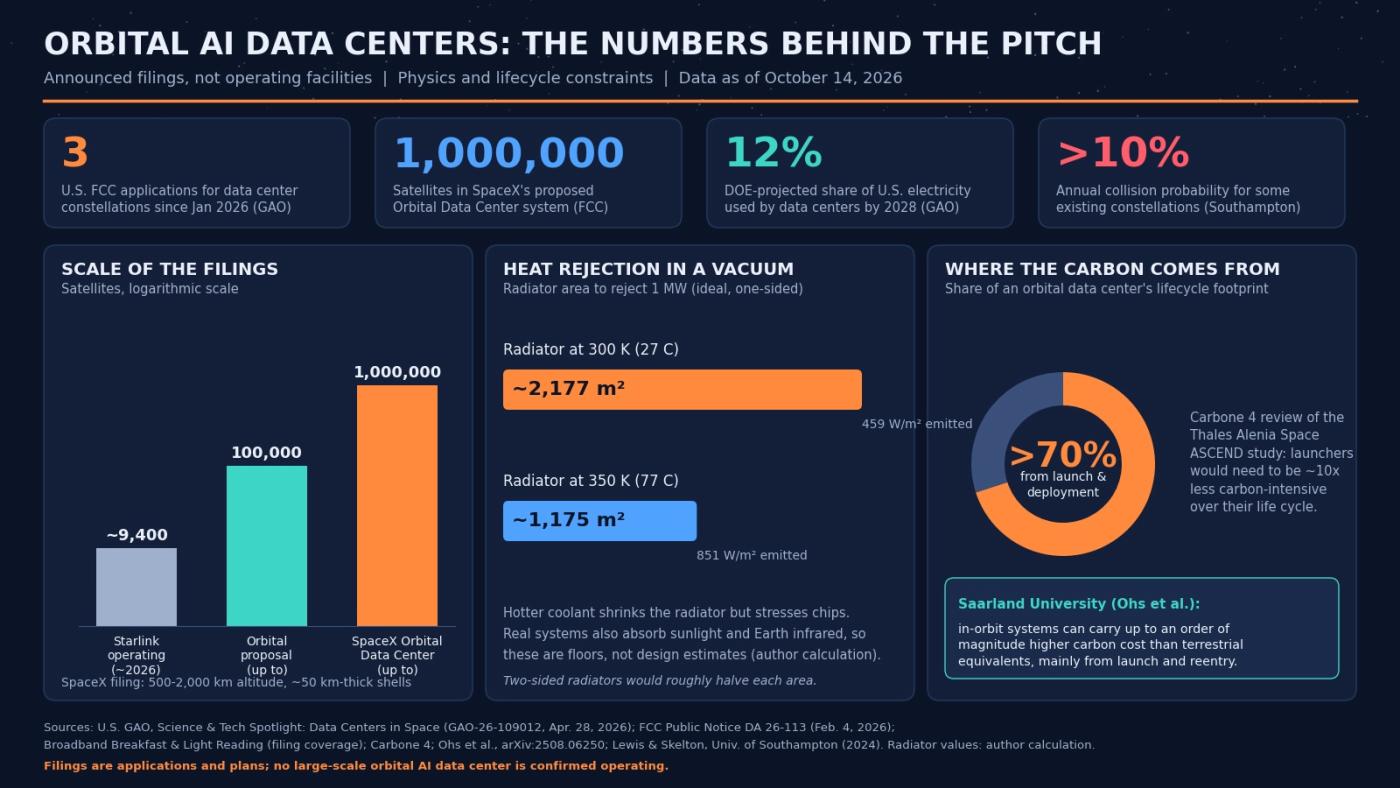
The pitch for data centers in orbit is easy to follow. AI is straining power grids, water supplies and local permitting boards, and space offers sunlight, empty volume and no neighbors. The U.S. Government Accountability Office's April 2026 Science & Tech Spotlight acknowledges the appeal. It says space-based data centers "could reduce the land, electricity, and water needed for data centers on Earth." The same two-page document also lists the obstacles. Heat is hard to shed in a vacuum, radiation damages hardware, repair capability is thin, and more satellites mean more collision risk.
This feature asks a narrower question than whether orbital computing can work. It asks whether the move reduces pressure on the planet or relocates it into forms that are harder to see, price and undo. The evidence so far suggests the second outcome is a live possibility.
What exists, and what is only on file
The first task is separating hardware from paperwork. The GAO says public and private projects are testing high-performance computing hardware and communications technology in space, with some data center satellites planned for the mid-2030s. It also says the Federal Communications Commission has received three applications since January 2026 from U.S. companies for large constellations operating as data centers. Those are filings, not operating facilities.
The largest is SpaceX's. An FCC public notice released February 4, 2026 describes a January 30 application for a new non-geostationary system of up to one million satellites. The company's narrative called it "a first step towards becoming a Kardashev II-level civilization," according to reporting on the filing. Trade coverage said the proposed shells would be about 50 km thick, between 500 km and 2,000 km altitude, and that SpaceX flies roughly 9,400 working Starlink satellites today. A second applicant, a startup called Orbital, filed in June. Light Reading reported it plans a single-GPU demonstration launch in 2027 and a first data center satellite in 2028. The records I reviewed show applications and plans. I found no evidence of operating orbital data centers at anything like the scale of a terrestrial campus, and I did not find a final FCC grant for the million-satellite request.
The vacuum does not cool anything
On Earth, a data center rejects heat mostly by moving it into air or water, which carry thermal energy away by convection and evaporation. In orbit that mechanism is unavailable. The GAO's key takeaway is blunt: "space does not cool computing hardware efficiently." The only exit for waste heat is infrared radiation, which scales with radiator area and with the fourth power of radiator temperature.
A simple calculation with stated assumptions shows the scale. Take an ideal radiator at 300 K that radiates from one face and absorbs nothing from the Sun or Earth. It sheds about 460 watts per square meter. A 1-megawatt computing load then needs roughly 2,200 square meters of radiator. Using both faces halves that. Running the coolant hotter at 350 K raises the figure to about 850 watts per square meter, but silicon runs less reliably and less efficiently as it gets hotter. Real radiators also absorb sunlight and Earth's infrared and carry plumbing and structure, so these numbers are floors and not estimates for any actual design.
The GAO says solar arrays larger than any launched and assembled in space as of April 2026 would be needed, and calls cooling at this scale "unproven." Power generation and heat rejection both scale with mass, and mass is what gets billed at launch. A terrestrial facility can overbuild a chiller plant cheaply. An orbital one pays for every extra square meter twice, once to build and once to lift.
Radiation, failure and the refresh problem
The GAO notes that space radiation "can corrupt data unpredictably and degrade hardware." Mitigation options include shielding, error-correcting designs and radiation-tolerant parts. Shielding adds mass. Tolerant parts typically trail commercial AI accelerators in performance. Redundancy spends capacity to buy reliability. Each choice moves cost somewhere else without removing it.
The larger issue is the replacement cycle. AI accelerators are commercially obsolete in a few years. A terrestrial operator swaps boards in a rack. An orbital operator must either launch a new satellite or accept aging hardware. The GAO says in-space servicing is "underdeveloped" and warns that data centers "might be decommissioned more frequently than other satellites, potentially increasing space debris or risks from atmospheric reentry." If the compute hardware ages out faster than the spacecraft around it, the launch and reentry burden recurs far sooner than a conventional satellite's design life implies.
Lifecycle emissions: the launch is the cost center
The environmental case for orbit rests on the operating phase. Solar arrays in a sun-synchronous orbit collect near-continuous sunlight, and operating electricity is the largest share of a terrestrial data center's footprint. A study by Singapore's Nanyang Technological University, published in Nature Electronics by Ablimit Aili and colleagues and listed as the GAO's selected reference, examines the path to carbon-neutral data centers in space. A European feasibility consortium led by Thales Alenia Space also found a potential benefit, but a conditional one. The Carbone 4 analysis of the project reported that more than 70 percent of an orbital data center's footprint came from deploying it, covering rocket and propellant production and the launch itself. It concluded that launchers would need to be roughly ten times less carbon-intensive over their lifecycle.
Researchers at Saarland University, led by Robin Ohs, took a harsher view. Their lifecycle analysis of launch, orbital operation and reentry concluded that "even under optimistic assumptions, in-orbit systems incur significantly higher carbon costs," mainly from embodied emissions at launch and reentry. A version of the paper puts the gap at up to an order of magnitude against terrestrial equivalents. These studies reach different conclusions because they draw their boundaries in different places. Counting only operating electricity favors space. Counting launch, manufacturing and reentry does not. That disagreement is the main finding. Any claim that orbital computing is greener depends on a launch technology that has not yet been demonstrated at the needed scale.
Some effects fall outside these models. NOAA scientist Daniel Murphy and colleagues reported in a 2023 PNAS study that metals from spacecraft reentry were already detectable in stratospheric aerosol particles. The atmospheric consequences of burning up large numbers of heavy computing satellites are not established. Shifting emissions from a power plant to the upper atmosphere is not obviously an improvement when the effects at altitude are poorly characterized.
Congestion is the shared-resource problem
The GAO warns that "a significant increase in the number of satellites in orbit could be difficult to manage and cause collisions," including with crewed missions, and that more satellites could interfere with astronomy. The agency also asks what information policymakers need to balance commercial growth against long-term stewardship of space.
NASA's Orbital Debris Program Office has studied this for years. Its modeling of large constellations found that even low-altitude spacecraft, though compliant with the 25-year disposal guideline, raise the risk of accidental explosions that create fast-moving fragments. The same research notes that fragmentation debris at 1,100 to 1,300 km can take thousands of years to decay. SpaceX's filing reaches 2,000 km, and it is reasonable to infer that failures in the upper shells would linger. NASA's chief scientist for orbital debris, Jer-Chyi Liou, said constellation operators must take care not to "pollute the near Earth space environment with significant orbital debris."
Operational evidence is already sobering. University of Southampton researchers Lewis and Skelton, using conjunction data and the DAMAGE model, found that some existing constellations still face more than a 10 percent annual collision probability even after substantial avoidance maneuvering. That risk applies to constellations that exist and are managed by operators with extensive experience. A proposal an order of magnitude larger inherits the problem at a much greater scale. SpaceX has said the shell spacing leaves "sufficient room to deconflict against other systems," according to trade coverage of its filing. Astronomer Peter Plavchan cautioned that a mass-produced constellation could occupy altitudes to near carrying capacity and block other actors.
Concentration, maintenance and the terrestrial baseline
Launch is the economic chokepoint. The GAO asks whether the United States has adequate launch and other facilities for a large increase in satellites. At the moment a single company is both the largest proposed orbital data center applicant and the dominant launch provider, and Orbital's own demonstration plans rely on a Falcon 9. Dependence on a vertically integrated supplier means launch pricing, cadence and priorities are set by a firm with its own computing interests. A smaller competitor's costs follow its competitor's price list.
Repair compounds the problem. On Earth a failed server is a ticket and a technician. In orbit, with servicing capability underdeveloped, a fault can mean losing the unit. The GAO's earlier work on in-space servicing and assembly points to the same gap. Until servicing is routine and affordable, replacement is the default repair strategy, which feeds the launch, emissions and debris loops described above.
The comparison also has to be fair to the ground. The GAO cites Department of Energy projections that data centers could reach up to 12 percent of U.S. electrical demand by 2028, and orbital computing is partly a response to that. But terrestrial constraints, including grid interconnection, water use, cooling design and siting, are engineering and policy problems with known tools, such as efficiency gains, dry or closed-loop cooling and demand management. They are slow and contested, but they are reversible and local in a way that orbital debris is not. A well-sited terrestrial facility can be retrofitted. A debris field cannot be recalled.
Who is accountable for the long tail
The GAO's policy questions point to the regulatory gap. It asks how existing laws, treaties and international agreements covering space or data would apply to data centers in orbit. Current licensing was built around communications satellites, with per-spacecraft disposal and casualty-risk rules. It was not built around a computing platform with a shorter refresh cycle, a heat budget that drives its size, and a business model tied to AI demand. Research cited by Canadian government consultants has already noted that per-satellite casualty-risk standards fit mega-constellations poorly, and the original Starlink design had to be revised to demise fully on reentry.
Commercial pressure makes the gap more consequential. Companies racing for AI capacity have strong incentives to file early and to claim orbital slots and spectrum before the engineering and lifecycle data exist. The GAO's last research question, about the safety, costs and life cycles of novel data centers including those in space, is still open. If deployment runs ahead of those answers, long-term costs will be learned in orbit, where mistakes are permanent in practical terms.
Relocation, not resolution
The physics, the lifecycle studies and the debris research point in the same direction. Orbital computing trades one set of burdens for another. Land, water and grid strain on Earth are exchanged for launch emissions, reentry products, replacement flights and a denser shared orbit. Some of these burdens may fall with better launchers, servicing and thermal design. None has been shown to fall far enough at scale, and the strongest claims for orbital data centers rest on assumptions not yet proven. Small systems that process space-collected data, which the GAO describes as nearer to maturity, may prove their value. The case for replacing or substantially supplementing large terrestrial AI facilities is far weaker. The responsible next step is to demand transparent boundaries in every lifecycle claim, binding disposal and servicing commitments before approval, and independent debris and atmospheric modeling at the proposed scale, before the first large constellation is built.