health
Why Heat Can Turn an Easy Workout Into a Strain
Exercise in hot climates is shaped by more than temperature. This evidence-based analysis examines how humidity, hydration, exercise intensity and heat acclimatization interact to change cardiovascular strain, thermoregulation and performance, explaining why the same workout can impose very different physiological stress on different days.





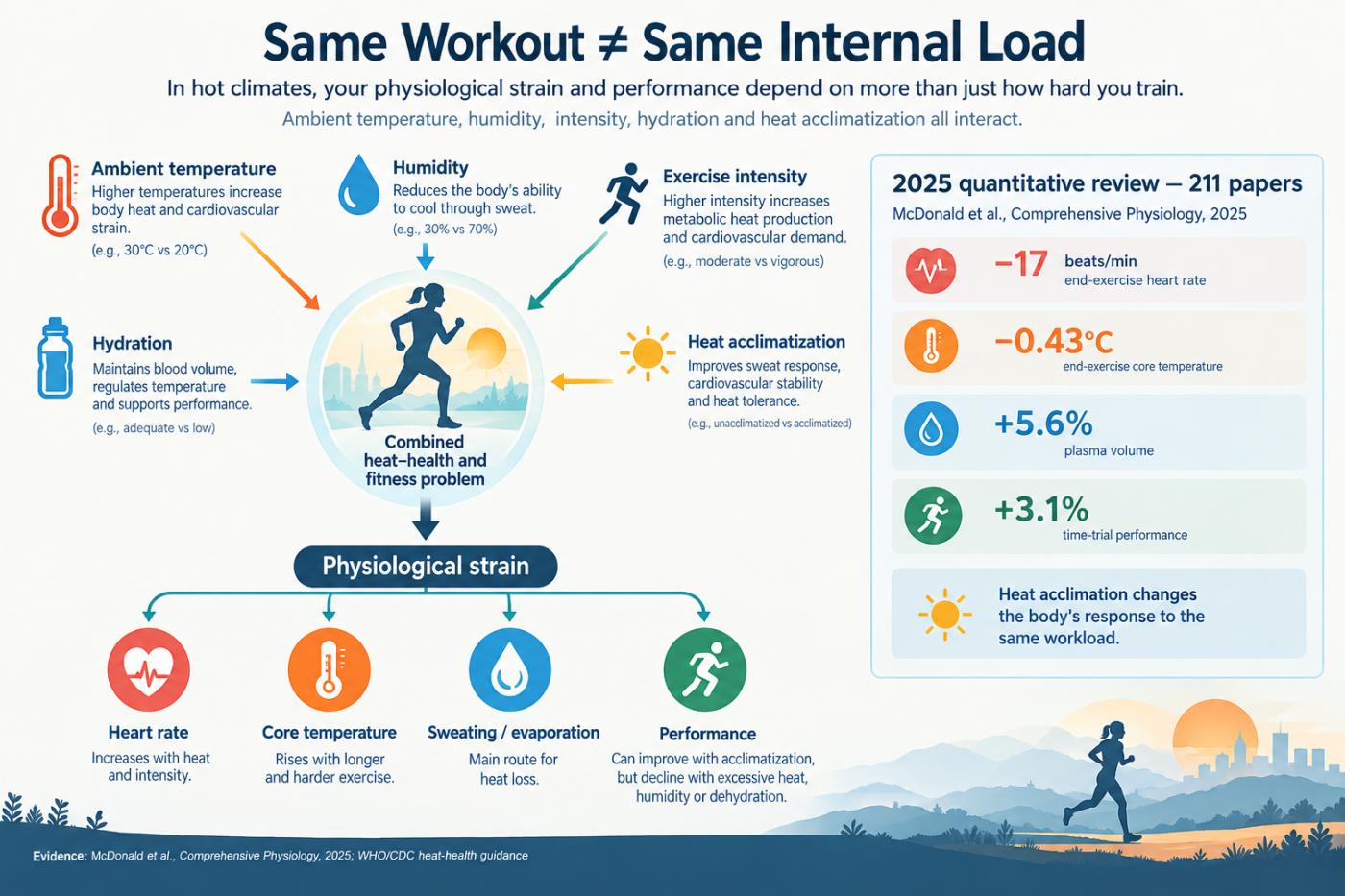
Why the Same Workout Can Become a Very Different Physiological Challenge
A 45-minute run, cycle ride or brisk outdoor workout looks like a fixed training prescription on paper. The body, however, does not experience exercise in isolation from its surroundings. The same pace, distance and duration can produce very different cardiovascular, thermal and perceptual strain depending on air temperature, humidity, wind, solar radiation, hydration status and how well the person has acclimatized to heat.
This matters because exercise in hot weather is not simply a fitness problem. It is simultaneously a thermoregulation problem. Muscles generate heat as they work, while the environment can either help the body dispose of that heat or make cooling progressively more difficult. The cardiovascular system must then support two competing demands: supplying working muscles with blood while also sending blood toward the skin for heat dissipation.
The American College of Sports Medicine (ACSM) explains the basic mechanism succinctly: During exercise, heat is produced from muscles
, while heart rate rises to help deliver blood to the skin and sweating contributes to cooling. The result is that environmental heat effectively adds another physiological workload to the workout.
That is why comparing outdoor workouts solely by pace, power, heart rate or duration can be misleading. Two sessions that appear identical in a training log may represent very different internal loads.
Heat Starts With the Body's Own Metabolic Furnace
Human movement is energetically inefficient. Only part of the chemical energy used by contracting muscles becomes external mechanical work; much of the remainder ultimately appears as heat. During exercise, the body therefore has to continually transfer internally generated heat from active tissues toward the skin and then from the skin into the environment.
In moderate conditions this process can work remarkably well. As exercise intensity rises, however, metabolic heat production rises too. The body responds by increasing skin blood flow and sweating. Heart rate therefore becomes partly a cooling variable rather than simply an indicator of cardiovascular exercise intensity.
This creates an important distinction between external workload and internal physiological strain. Running at 10 km/h remains 10 km/h whether the temperature is 20°C or 35°C. But the cardiovascular and thermoregulatory cost of maintaining that speed can be substantially higher in the hotter environment.
A controlled study by researchers examining temperature and humidity illustrates the point. Fourteen trained participants performed cycling exercise and a subsequent 20-km time trial under different combinations of temperature and humidity. At the same absolute humidity, increasing air temperature from 18°C to 36°C increased skin temperature, heart rate and sweat rate. Time-trial performance in the hot condition was approximately 3.6-6% slower than in the cooler conditions.
The practical implication is significant: a slower pace on a hot day does not necessarily mean poorer fitness. The athlete may be producing a similar relative effort while deliberately or involuntarily reducing external output to control thermal strain.
Temperature Is Only Half of the Environmental Equation
Humidity changes the problem because sweating only cools the body when sweat can evaporate. Sweat sitting on the skin represents fluid loss, but relatively little cooling occurs if the surrounding air is already saturated with water vapour.
This is why 32°C in dry air and 32°C in very humid air can feel and physiologically behave very differently. In dry conditions, substantial sweat may evaporate and remove heat. In humid conditions, evaporation becomes increasingly constrained, so the body may continue producing sweat without receiving the same cooling benefit.
Research published in 2025 provides particularly clear experimental evidence. In a study of self-paced cycling, increasing humidity progressively reduced the environment's maximum evaporative capacity. Under the highest humidity condition, evaporative capacity was approximately one-third of that observed under the lowest humidity condition, while sweating efficiency also fell substantially. Peak core temperature reached approximately 39.5°C under the very-high-humidity condition, compared with about 39.0°C under low humidity, and power output was significantly reduced.
The researchers therefore demonstrated something that a conventional temperature reading cannot capture: more sweating does not necessarily mean more cooling. In humid conditions, the body may increase sweat production while simultaneously becoming less capable of converting that sweat into evaporative heat loss.
For people exercising in tropical or monsoon climates, this is particularly important. A forecast showing a modest air temperature may conceal a substantial thermoregulatory burden if water-vapour pressure is high.
Why Wind, Sun and Clothing Matter Too
Temperature and humidity are not the complete environmental picture. Wind can increase convective and evaporative heat loss, while direct solar radiation can add heat to the body. Shade can therefore materially change exposure even when an outdoor thermometer records exactly the same air temperature.
The World Health Organization's 2026 heat-and-health guidance emphasizes that heat exposure is determined by a combination of environmental conditions, including temperature, humidity, wind and thermal radiation. WHO notes that heat accumulation occurs when the body cannot adequately eliminate internally generated heat or environmental heat gain.
Clothing adds another layer. Clothing that restricts airflow or traps moisture can reduce the effectiveness of sweating. Conversely, lightweight clothing that permits airflow and evaporation can improve heat exchange. For outdoor exercise, the difference between running in shade with moving air and running in direct sun on a still day can therefore be much greater than the thermometer alone suggests.
Humidity Changes the Meaning of Sweat
Sweating is one of the body's most powerful cooling mechanisms, but it comes with a cost. Sweat removes water and electrolytes from the body, while maintaining circulation to the skin requires cardiovascular adjustments.
As dehydration progresses, plasma volume can decline. The heart may have to beat faster to maintain cardiac output, particularly while simultaneously supplying the skin and working muscles. This is one reason heart rate can drift upward during a prolonged workout even when running speed or cycling power remains unchanged.
Research has consistently shown that dehydration becomes more consequential during exercise in the heat. A review by Susan Shirreffs reported that approximately 2% body-mass loss during exercise in temperatures around 31-32°C impairs endurance performance, whereas the same degree of loss appears to have a smaller effect in temperate conditions.
Importantly, this does not mean that every athlete must force large quantities of fluid into the body. Hydration requirements vary according to sweat rate, body size, exercise duration, environmental conditions and individual physiology. Excessive drinking can itself create dangerous electrolyte disturbances. The more useful concept is therefore maintaining an appropriate hydration state rather than pursuing an arbitrary volume of water.
A more recent experimental study reinforces the interaction between hydration and heat. Trained cyclists who became approximately 2% dehydrated during exercise in hot conditions subsequently performed a cycling time trial better after replacing much of the lost fluid than when they remained dehydrated.
Exercise Intensity Acts Like a Heat Multiplier
Environmental stress does not operate independently of exercise intensity. The harder the muscles work, the more metabolic heat they generate. A temperature that is manageable during an easy walk may become problematic during intervals, hill repeats or a high-intensity cycling session.
This creates a useful conceptual model: heat stress is the interaction between environmental heat load and metabolic heat production. Increasing either side can increase the total thermal challenge.
This also explains why a prescribed pace can become inappropriate on a hot day. Suppose a runner normally completes a tempo session at a particular pace in cool weather. Attempting to maintain exactly the same pace when environmental heat substantially increases thermal strain may force the body to devote more cardiovascular capacity to cooling. Eventually, the athlete may reach a level of physiological strain that cannot be reconciled with maintaining the original workload.
Self-paced exercise partially solves this problem because people naturally slow down as thermal and perceptual strain rise. Fixed-workload exercise does not provide the same protection: the body is required to maintain the external workload even as the internal cost rises.
Heat Acclimatization Changes the Equation
One of the most important reasons two people can experience the same workout differently is heat acclimatization. Repeated exposure to exercise in the heat produces physiological adaptations that improve heat dissipation and cardiovascular stability.
These adaptations include earlier onset of sweating, increased sweat production, changes in sweat electrolyte concentration, expanded plasma volume, improved skin blood flow and a lower heart rate and core temperature at a given workload.
The U.S. National Institute for Occupational Safety and Health (NIOSH) describes acclimatization as a set of beneficial physiological adaptations produced by repeated heat exposure. Its 2026 guidance notes that acclimatized individuals can perform work with lower core temperature and heart rate and that adaptation generally develops progressively over approximately 7-14 days.
Recent research suggests that the adaptation process is not merely a matter of becoming psychologically comfortable with hot weather. Peter McDonald, Harry Brown, Thomas Topham and colleagues analyzed 211 papers in a 2025 quantitative review. Their meta-analysis estimated that heat acclimation reduced end-exercise heart rate by about 17 beats per minute and end-exercise core temperature by approximately 0.43°C, while expanding plasma volume by about 5.6%. Time-trial performance improved by approximately 3.1% across the included research.
The authors concluded that HA protocol characteristics influence the adaptive response
. In other words, acclimatization is not an all-or-nothing switch. The number of exposures, duration, environmental conditions and exercise protocol influence the adaptations achieved.
Acclimatization Is Not the Same as Fitness
Athletic fitness and heat acclimatization overlap but are not interchangeable. A highly trained runner who normally lives and trains in a cool climate can be exceptionally fit while still being poorly adapted to sudden exposure to intense heat.
Conversely, someone who regularly exercises in a hot environment may have developed substantial thermoregulatory adaptations even if their aerobic fitness is only moderate.
Fitness can nevertheless influence heat tolerance. ACSM notes that improving aerobic fitness can improve the ability to adapt to exercise in heat. But fitness does not eliminate environmental stress. A highly fit person can still experience dangerous heat strain when environmental conditions, exercise intensity and hydration status combine unfavourably.
Why One Hot Day Can Differ From Another
The phrase “hot day” hides several independent variables. Consider two workouts performed at the same pace for the same duration:
- Day A: 25°C, moderate humidity, morning, light wind, shaded route and good hydration.
- Day B: 33°C, high humidity, afternoon sun, little wind and some pre-existing fluid deficit.
The external prescription is identical, but the internal workload is not. Day B simultaneously increases environmental heat gain, reduces evaporative cooling, raises the body's demand for skin blood flow and increases the likelihood of progressive dehydration. If the person is also unacclimatized, the cardiovascular and thermal response can be amplified further.
This is why temperature alone is a poor measure of exercise difficulty. A more useful mental model is a heat-stress budget: environmental heat, humidity, solar exposure, clothing and wind determine how difficult cooling is, while exercise intensity and duration determine how much metabolic heat must be removed.
What the Guidance Means for Everyday Exercise
Official public-health guidance does not suggest treating every warm workout as dangerous. Instead, it emphasizes modifying exposure when heat becomes excessive and recognizing warning symptoms early.
The U.S. Centers for Disease Control and Prevention advises people exercising on hot days to pace activity, start gradually, drink more water than usual and move activity toward cooler parts of the day. It specifically states: If you feel faint or weak, STOP all activity and get to a cool place.
WHO's 2026 advice similarly recommends avoiding strenuous activity during the hottest part of the day and keeping the body cool and hydrated. The guidance is particularly relevant because heat risk is not uniform: acclimatization, age, health status, exposure duration and local environmental conditions all influence the response.
For training purposes, this suggests a practical shift from asking “What pace should I run today?” to asking “What physiological load is today's environment likely to impose?” On hotter days, reducing intensity, shortening the session, moving indoors or exercising during cooler hours can preserve the training objective without unnecessarily increasing thermal strain.
Using Heart Rate and Perceived Effort as Environmental Signals
Heat can also change how familiar training metrics should be interpreted. If heart rate is substantially higher than normal at a familiar pace, the difference may reflect environmental strain rather than a sudden change in cardiovascular fitness.
Similarly, perceived exertion can rise even when mechanical output remains constant. The athlete is not imagining the additional difficulty: maintaining circulation, skin blood flow, sweating and temperature regulation consumes physiological resources.
For endurance athletes, therefore, environmental conditions should be recorded alongside pace and heart rate. Temperature, humidity, time of day, wind, route exposure and hydration can provide essential context when comparing sessions across weeks or seasons.
The Fitness Lesson: Adapt the Workout, Not Just the Athlete
Heat acclimatization is valuable because it expands the body's capacity to cope with thermal stress. But acclimatization should not be interpreted as permission to ignore environmental conditions. Even an acclimatized athlete has limits, particularly when high humidity restricts evaporation or when exercise intensity generates large amounts of metabolic heat.
The more useful approach is to treat heat as another training variable. In cool conditions, pace or power may dominate workout prescription. In hot conditions, environmental load becomes part of the prescription itself.
This produces a broader understanding of fitness. A workout is not simply a quantity of kilometres, minutes or watts. It is an interaction between external work and the body's internal response. Two identical workouts can therefore have different training consequences and different safety margins because the atmosphere surrounding the athlete has changed.
That is the central reason exercise in hot climates should be viewed as both a heat-health and fitness problem. Temperature determines part of the heat load, humidity determines how effectively sweat can remove that heat, exercise intensity determines how much heat the muscles generate, hydration influences cardiovascular and thermoregulatory capacity, and acclimatization changes how efficiently the body manages the entire system. The workout may look identical in a training diary, while the physiological challenge underneath it is fundamentally different.