health
When More Exercise Stops Being the Main Answer
More exercise can improve health, but maximizing workout minutes is not the same as maximizing health. This evidence-based analysis examines exercise volume, sedentary behaviour, intensity, recovery, ageing, disability, chronic disease, heat and air pollution to explain why the optimal activity strategy must be adapted to both the individual and the environment.





The Problem With Treating Exercise as a Number to Maximize
“More exercise is better” sounds like an uncomplicated health rule. At one level, the evidence strongly supports the idea behind it: moving from inactivity to some physical activity produces substantial health benefits, and higher activity volumes are generally associated with lower risks of cardiovascular disease, type 2 diabetes, some cancers and premature death.
But that is not the same as saying that health improves simply by maximizing workout minutes.
The body does not experience exercise as an isolated number. It experiences a combination of movement, intensity, sitting, sleep and recovery, age, physical capacity, chronic disease, disability and environmental conditions. A 60-minute run after eight hours of sitting is not physiologically equivalent to an otherwise identical day containing frequent movement breaks. Nor is a two-hour outdoor workout necessarily the healthier choice when temperatures are extreme or air pollution is high.
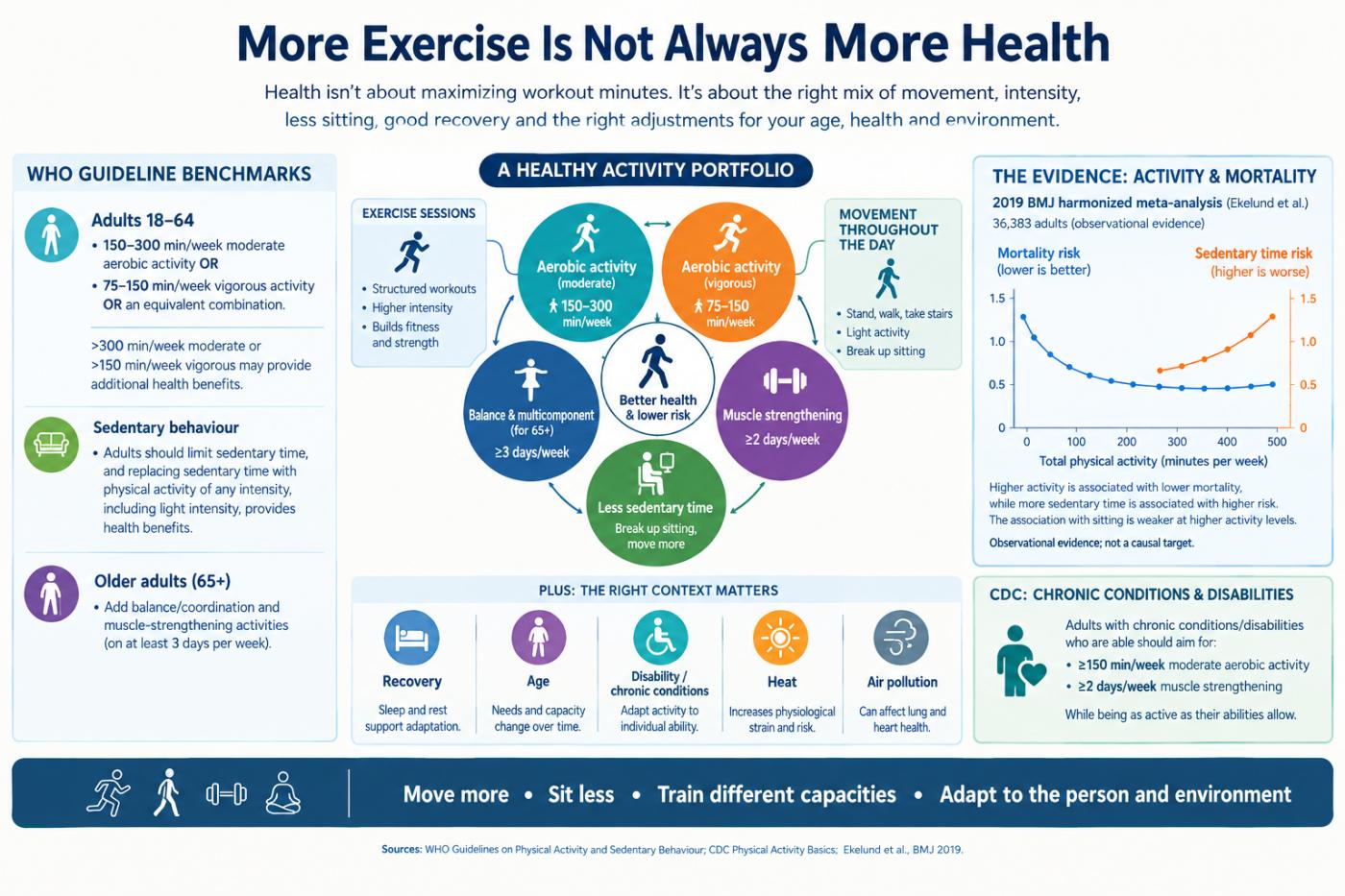
The World Health Organization's physical-activity guidelines deliberately avoid presenting exercise as a single weekly target. They address aerobic activity, muscle strengthening, sedentary behaviour, older adults, disability and chronic conditions together. WHO's central message is that “everyone can benefit from increasing physical activity and reducing sedentary behaviour.”
That wording is important. The goal is not maximum exercise. It is a healthier distribution of movement and inactivity that fits the person's capacity and circumstances.
From “How Much?” to “What Is the Whole Day Doing?”
For decades, physical activity advice was commonly translated into a simple number: 150 minutes of moderate activity per week. That number remains important. WHO recommends adults accumulate 150-300 minutes of moderate-intensity aerobic activity, or 75-150 minutes of vigorous activity, or an equivalent combination, together with muscle-strengthening activity on at least two days each week.
But the same guidelines also address sedentary behaviour. This changes the interpretation of the weekly target. A person can complete the recommended exercise and still spend most of the remaining waking day sitting.
Research using objective accelerometer measurements makes the distinction particularly interesting. In a harmonized meta-analysis of nine prospective cohorts involving more than 44,000 middle-aged and older adults, Ulf Ekelund and colleagues found that mortality risk was associated with both moderate-to-vigorous physical activity and sedentary time. Among the least active participants, greater sedentary time was particularly strongly associated with mortality. In the highest activity group, however, the statistical association between sedentary time and mortality was much weaker. The researchers estimated that roughly 30-40 minutes of moderate-to-vigorous activity per day substantially attenuated the mortality association with high sedentary time.
This does not mean that 30-40 minutes of exercise “cancels out” sitting in a literal biological sense. It means that activity volume and sedentary time interact, rather than operating as two completely independent variables. The study was observational, so it cannot establish that changing sitting or exercise by itself caused the observed differences.
That distinction produces a useful conceptual shift: health is influenced not only by how much you exercise, but by how the remaining hours of the day are spent.
Why Breaking Up Sitting Is a Different Goal From Going to the Gym
Exercise sessions and ordinary movement are not interchangeable. A structured workout is usually designed to produce a sufficiently large physiological stimulus to improve cardiovascular fitness, strength or other capacities. Breaking up prolonged sitting serves a different purpose.
Standing up, walking around the room, taking stairs, doing household tasks or moving between meetings may not constitute a conventional “workout,” but these activities change the amount of time spent completely inactive.
Research by Ekelund and colleagues published in BMJ in 2019 similarly found that the association between sedentary behaviour and mortality became weaker as physical activity increased. Their dose-response analysis of hundreds of thousands of participants suggested that activity should be considered alongside sedentary time rather than as a completely separate variable.
This does not establish that every sitting interruption produces a specific measurable reduction in mortality. Rather, it supports a broader principle: adding movement throughout the day and adding formal exercise solve different parts of the physical-activity problem.
More Activity Usually Helps but the Returns Change
The evidence does not support the idea that exercise suddenly becomes harmful once someone passes 150 or 300 minutes. In fact, observational research generally finds additional benefits at activity levels above the minimum guideline.
A large prospective cohort analysis by Rikardsson and colleagues, published in 2022, found that people achieving approximately 150-300 minutes of moderate leisure-time activity per week had substantially lower mortality than inactive participants. Additional activity above the guideline was associated with further reductions in risk, although the incremental associations became smaller at higher volumes. In that study, very high amounts of activity did not clearly demonstrate additional mortality reductions beyond already-high levels, but neither did they clearly demonstrate harm.
A much larger 2023 dose-response meta-analysis by Leandro Garcia-Hermoso and colleagues examined 196 articles covering more than 30 million participants. It found broad health benefits from increasing non-occupational physical activity, but the relationship was not simply a straight line in which every additional minute produces the same magnitude of benefit.
That pattern matters. Moving from zero activity to a modest amount can represent a large change in health risk. Moving from a moderate amount to a very high amount may produce smaller additional population-level benefits.
A newer U.S. cohort analysis published in 2026 illustrates the same phenomenon from another direction. Among approximately 594,000 adults, even five minutes of moderate-to-vigorous activity per week was associated with lower mortality than no activity, while the largest gains occurred when people moved from inactivity toward modest activity. The researchers found progressively lower mortality associations through higher volumes, including 150, 300 and 600 minutes per week. These are observational associations, not evidence that everyone should pursue 600 minutes.
The practical implication is therefore not “stop at 300 minutes.” It is that the marginal value of another workout should be considered in context.
Intensity Changes What “More” Means
Two people can accumulate the same number of minutes while receiving very different physiological stimuli.
Moderate walking, vigorous running, resistance training and balance exercises address different capacities. WHO therefore recommends a combination rather than simply accumulating aerobic minutes. Muscle-strengthening activity is separately recommended because cardiovascular endurance does not substitute completely for maintaining muscular strength and functional capacity.
This becomes especially important with ageing. Adults aged 65 and older receive recommendations for aerobic activity and muscle strengthening, but WHO additionally recommends varied multicomponent activity emphasizing functional balance and strength on at least three days per week. The objective is not merely to preserve cardiovascular capacity; it includes maintaining function and reducing falls.
A person who replaces all of their activity with endurance exercise may therefore accumulate impressive weekly minutes while neglecting a capability that becomes increasingly important with age.
Age Changes the Objective of Exercise
Age does not turn exercise into something optional. Quite the opposite: physical activity remains important throughout life. But the health problem being addressed can change.
For a younger adult, improving aerobic capacity or developing strength may be a prominent objective. For an older adult, preserving muscle power, balance, mobility and independence can become equally important. WHO specifically links physical activity in older adults with improved functional ability and fall prevention.
Recovery can also become more important when training volume or intensity rises. The fact that a person can physically complete another workout does not establish that another hard session is the most useful training stimulus. Adaptation occurs in the context of recovery, and excessive training load can produce persistent fatigue, impaired performance and other symptoms associated with inadequate recovery.
This is one reason a health-oriented activity strategy should not confuse capacity to exercise with need to exercise more. The latter depends on what the person is trying to improve and what other stresses the body is experiencing.
Chronic Disease Changes the Meaning of “Enough”
WHO and CDC guidance specifically includes people living with chronic conditions rather than treating them as exceptions to physical-activity recommendations.
The CDC's current guidance states that adults with chronic health conditions or disabilities who are able should aim for at least 150 minutes of moderate aerobic activity per week plus muscle-strengthening activity on at least two days. It also explicitly recognizes that some people cannot meet those targets and should instead be as active as their abilities allow.
The CDC puts this principle plainly: Some physical activity is better than none be as active as you are able!
That is substantially different from a universal “push harder” philosophy.
Chronic conditions can alter exercise tolerance, recovery, balance, heat tolerance, medication effects and the types of movement that are practical. Arthritis, cardiovascular disease, diabetes, neurological conditions and respiratory disease can all require adaptations without eliminating the benefits of physical activity.
For some people, therefore, the most valuable additional activity may be low-impact aerobic movement, resistance training with adaptations, aquatic exercise, wheelchair propulsion, balance work or short bouts distributed throughout the day rather than another high-intensity workout.
Disability Makes the Maximization Model Even Less Useful
Disability illustrates why population guidelines should not be converted into competitive targets.
WHO includes people living with disability in its physical-activity recommendations, but the recommendations recognize that activity may need to be adapted. CDC guidance similarly lists walking, wheelchair rolling, cycling, swimming, water aerobics, resistance bands and adapted yoga among possible forms of activity.
The relevant question is therefore not whether someone can reproduce an able-bodied exercise routine. It is whether they can accumulate meaningful movement that improves cardiovascular health, strength, function, independence or quality of life within their capabilities.
For someone whose mobility is limited, a small increase in activity may represent a major physiological and functional change even if the absolute number of minutes is far below a conventional fitness target.
Heat Can Turn Additional Exercise Into Additional Environmental Stress
Exercise volume cannot be evaluated independently of the environment.
During exercise, muscles generate heat. In hot weather, the body must simultaneously deliver blood to working muscles and the skin while sweating to dissipate heat. Increasing workout duration or intensity therefore increases both metabolic workload and the duration of environmental exposure.
CDC heat guidance specifically identifies outdoor exercise as a situation in which heat-related illness risk rises. The agency recommends scheduling activity during cooler periods, pacing activity, staying hydrated and stopping activity if symptoms such as weakness or faintness occur.
The CDC's 2026 heat guidance also identifies older adults and people with chronic health conditions among groups that may require additional precautions. That means an additional hour of exercise on a cool morning and an additional hour of vigorous outdoor exercise during a heat wave should not be regarded as equivalent health investments.
Heat can also interact with medication and underlying disease. Some medications can affect hydration, sweating or thermoregulation, potentially altering heat tolerance. Consequently, the amount of exercise that is appropriate on an unusually hot day can differ from the amount that would be reasonable under normal conditions.
Air Pollution Creates Another Exercise Trade-Off
Outdoor exercise introduces another variable: what is being inhaled while ventilation increases.
Exercise increases breathing frequency and the amount of air passing through the respiratory system. When that air contains particulate matter, ozone or traffic-related pollutants, the dose inhaled during a workout can increase.
A 2026 systematic review and meta-analysis by Sijia Jiang, Yuqin Su, Hansen Li and colleagues examined 35 controlled trials involving healthy participants exercising under different pollution conditions. The analysis found modest but consistent adverse changes in several pulmonary and cardiovascular measures, including reductions in some measures of lung function and a modest increase in systolic blood pressure. The authors emphasized that the evidence concerning inflammatory and hematological outcomes was considerably less certain.
Importantly, this does not overturn the health benefits of physical activity. WHO's guidance on physical activity and air pollution says regular activity should generally continue, but advises adapting the timing and location of exercise to reduce pollution exposure. For people at higher risk, WHO recommends reducing moderate-to-vigorous outdoor activity during high-pollution episodes.
This produces another reason why “more outdoor exercise” is not automatically better. If pollution is unusually high, moving the same workout indoors or postponing it until air quality improves can preserve the physical-activity stimulus while reducing environmental exposure.
Heat and Pollution Can Arrive Together
The environmental variables can also interact. Hot weather can worsen ozone pollution, while stagnant atmospheric conditions can contribute to poor air quality. CDC explicitly notes the connection between warmer temperatures and unhealthy air quality.
This creates a particularly important problem for outdoor endurance exercise. A long, hard workout increases metabolic heat production, cardiovascular demand and ventilation at exactly the time when environmental heat and inhaled pollutants may also be elevated.
In such circumstances, adding another hour is not merely adding another hour of exercise. It is adding another hour of exposure to the environmental conditions surrounding that exercise.
The Better Model: Optimize the Activity Portfolio
A more useful fitness strategy therefore resembles a portfolio rather than a single target.
First, reduce inactivity. If most of the day is sedentary, frequent movement can address a dimension that a single workout cannot completely replace.
Second, establish an aerobic base. Work toward the WHO/CDC recommended range according to individual ability, using moderate and vigorous activity in an appropriate combination.
Third, preserve strength. Include muscle-strengthening activity at least twice a week, because aerobic fitness does not fully address muscular capacity.
Fourth, add balance and functional movement with age. Older adults particularly benefit from multicomponent activity that addresses balance, strength and functional capacity.
Fifth, respect recovery. More training is not automatically more adaptation. Training should be compatible with sleep, nutrition, age, accumulated fatigue and the individual's ability to recover.
Sixth, treat the environment as part of the workout. Heat, humidity, air pollution and extreme weather can change the physiological cost of the same external exercise prescription.
Finally, adjust for the person. Disability and chronic disease do not invalidate physical activity. They change how activity should be selected, dosed and adapted.
The Most Useful Fitness Question May Not Be “How Much More?”
The evidence does not support abandoning the idea that more physical activity can produce more health benefits. Rather, it shows why that relationship should not be interpreted as an instruction to maximize exercise minutes indefinitely.
For a sedentary person, the first additional minutes may be extraordinarily valuable. For someone already active, the next hour may provide a smaller incremental benefit and impose a larger recovery or environmental cost. For an older person, replacing some additional endurance work with strength and balance may address more important functional risks. For someone with a disability or chronic condition, adapting movement to capability may matter more than reaching a standardized numerical target. During extreme heat or poor air quality, changing when and where exercise occurs may improve the overall risk-benefit balance without reducing physical activity over the long term.
The most complete interpretation of the WHO and CDC guidance is therefore not “exercise as much as possible.” It is closer to move more, sit less, train the capacities that matter, recover sufficiently, and adapt the dose to the person and the environment.
That framework also explains why there is no single optimal number of workout minutes for everyone. Human health is not produced by exercise volume alone. It emerges from the interaction between movement, inactivity, intensity, recovery, biological capacity and the environment in which physical activity takes place.