business
Startups Mint India’s New Billionaires
India’s billionaire population is projected to grow 51% by 2031, driven by IPO exits, ESOP windfalls, and capital market participation, marking a shift from dynastic industrial wealth to startup-driven fortunes.





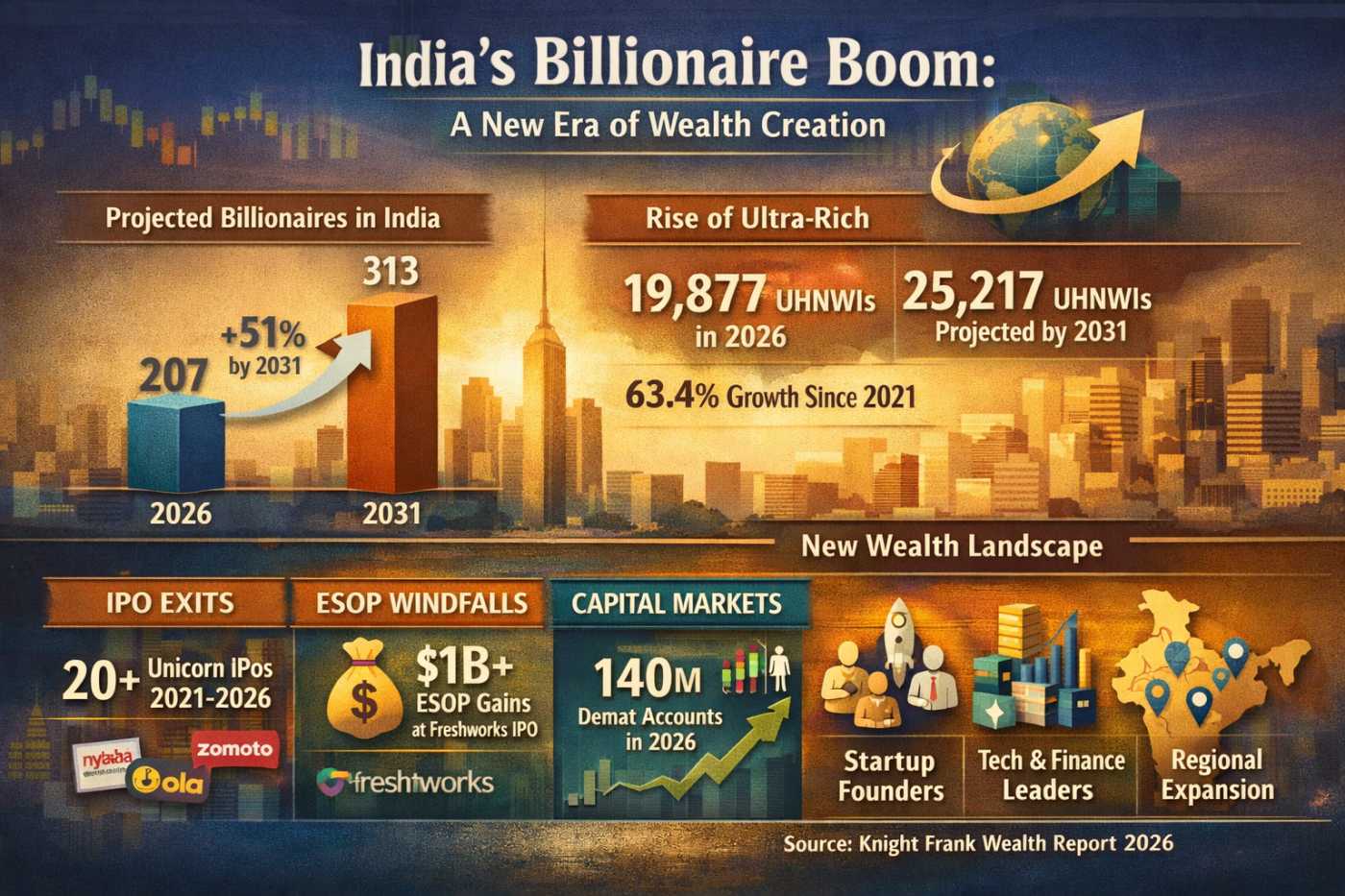
India is witnessing a historic transformation in wealth creation: Knight Frank projects the country’s billionaire population will surge 51% from 207 in 2026 to 313 by 2031, the fastest growth rate among major economies. Unlike the dynastic fortunes of the past, this new wave is increasingly minted through IPO exits, ESOP windfalls, and capital market participation.
The Billionaire Boom: Data and Projections
According to the Knight Frank Wealth Report 2026, India’s ultra-high-net-worth individual (UHNWI) population grew 63.4% between 2021 and 2026, reaching 19,877 individuals with assets over $30 million. The report forecasts a further 27% rise to 25,217 UHNWIs by 2031, alongside a 51% increase in billionaires to 313. This trajectory places India as the fastest-growing wealth hub globally, outpacing China and the United States in billionaire growth rates.
From Real Estate to IPOs: Shifting Wealth Engines
Historically, India’s billionaire class was dominated by industrialists and real estate magnates. The Ambanis, Adanis, and DLF’s K.P. Singh epitomized fortunes built on commodities, infrastructure, and property. Today, however, wealth creation is increasingly tied to financialisation and startup liquidity events. As Shishir Baijal, Chairman and MD of Knight Frank India, noted: “The expansion of India’s wealth club mirrors its economic evolution as it becomes a more entrepreneurial economy maturing into one with deeper capital pools, more sophisticated financial markets and a growing cohort of globally connected founders and investors.”
IPO Exits and Startup Liquidity
India’s startup ecosystem has matured dramatically. Between 2021 and 2026, over 20 unicorns went public, including Zomato, Nykaa, and Paytm. These IPOs created liquidity events that minted first-generation billionaires and multimillionaires. Founders who once relied on venture capital rounds are now building enduring fortunes through public markets. For example, Zomato’s 2021 IPO not only enriched its founders but also delivered significant ESOP windfalls to employees, democratizing wealth creation within the company.
ESOP Windfalls: Employees as Wealth Creators
Employee Stock Ownership Plans (ESOPs) have become a powerful driver of wealth distribution. In companies like Flipkart, Byju’s, and Freshworks, ESOPs have created hundreds of millionaires. When Freshworks listed on Nasdaq in 2021, its employees collectively gained over $1 billion in stock value. This phenomenon is reshaping India’s wealth anatomy by spreading gains beyond founders to early employees, creating a broader base of affluent individuals who may eventually join the billionaire ranks.
Capital Market Participation
India’s equity markets have deepened significantly. Retail participation has surged, with over 140 million demat accounts registered by 2026, up from 80 million in 2021. The Nifty 50 index delivered strong returns, buoyed by sectors like technology, pharmaceuticals, and renewable energy. This democratization of capital markets has allowed wealth to compound faster and more widely. Venture capital inflows, private equity, and family offices are also playing a larger role, creating a diversified ecosystem for wealth creation.
Regional Diversification of Wealth
Mumbai remains India’s wealth capital, but Knight Frank notes its declining share as fortunes spread to Delhi, Bengaluru, Chennai, and Hyderabad. This decentralization reflects regional economic expansion, infrastructure growth, and the rise of tech hubs outside traditional financial centers. Bengaluru, with its concentration of startups, has become a key incubator of new billionaires, while Hyderabad’s pharmaceutical and biotech industries are also contributing to wealth creation.
Contrasts with Old Wealth
The contrast between old and new wealth is stark. Industrialist dynasties relied on monopolistic control of commodities, land, and infrastructure. Their fortunes were often intergenerational, tied to family-owned conglomerates. In contrast, today’s billionaires are often first-generation entrepreneurs, tech founders, or financial market participants. Their wealth is more liquid, globally connected, and diversified across asset classes. This shift signals a broader democratization of wealth creation, though inequality remains a pressing issue.
Global Context and India’s Role
Globally, the ultra-rich population hit a record 713,626 in 2026, with nearly 89 new individuals crossing the $30 million threshold daily. India’s rapid rise positions it as a counterbalance to the US and China in shaping global wealth distribution. If current trends hold, India could surpass several developed economies in UHNWI rankings within the next decade.
Implications for the Future
India’s wealth creation is entering a new phase defined by financialisation, digitalisation, and entrepreneurial dynamism. IPO exits, ESOP windfalls, and capital market participation are reshaping the billionaire class, making it more diverse and globally integrated. While inequality and concentration of wealth remain challenges, the anatomy of Indian wealth is undeniably shifting from dynastic industrialists to a new generation of startup-driven billionaires.