business
India's Biggest IPO Has a Bigger Meaning
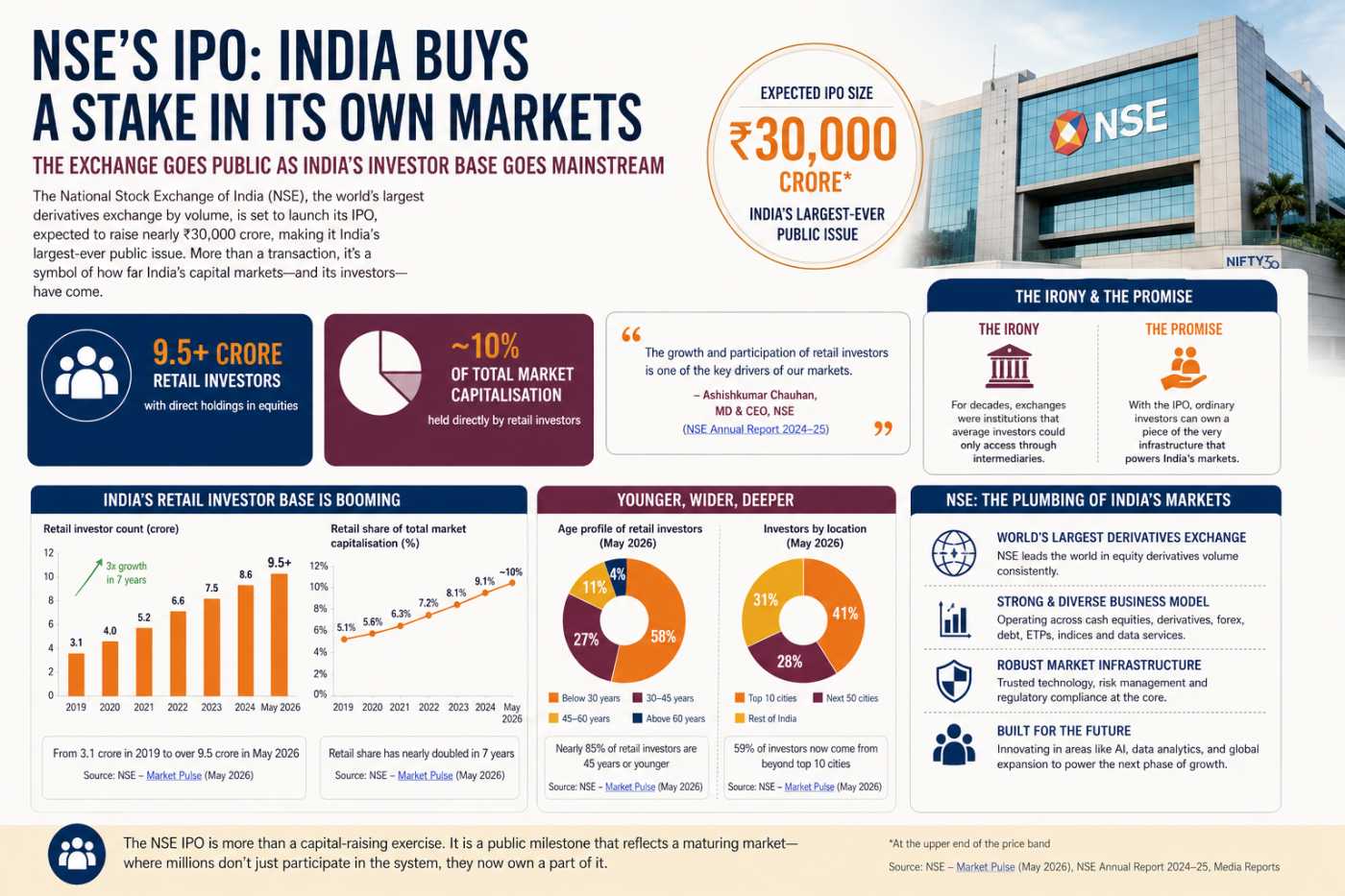
The NSE's planned ₹30,000 crore IPO is more than a record-breaking public issue. It symbolizes the rise of over 9.5 crore retail investors, the democratization of market participation, and the moment ordinary Indians can own a stake in the infrastructure powering the country's financial markets.





The Exchange That Taught India to Invest Is About to Become an Investment Itself
If India's capital markets had a defining symbol for the past three decades, it would almost certainly be the National Stock Exchange (NSE). Since its launch in 1994, the NSE has transformed how Indians invest, replacing open-outcry trading floors with electronic markets, democratizing access to equities, and helping create one of the world's most sophisticated financial infrastructures.
Now, in a development rich with symbolism, the exchange itself is preparing to go public. The NSE's long-awaited initial public offering (IPO), expected by market participants to raise close to ₹30,000 crore and potentially become India's largest-ever public issue, is more than a corporate finance event. It is a milestone that reflects how profoundly Indian market participation has changed.
The irony is difficult to miss. For decades, ordinary investors could buy shares in listed companies that traded on the NSE, but they could not own a piece of the exchange that made those transactions possible. The institution that served as the plumbing of India's capital markets remained largely inaccessible to the public. Its planned IPO changes that equation. For the first time, millions of retail investors may be able to purchase a stake in the infrastructure through which they invest.
The timing is particularly notable because the investor base itself has undergone a historic transformation. According to National Stock Exchange data released through its Market Pulse publications and annual disclosures, India now has more than 9.5 crore unique retail investors directly participating in equity markets. Retail investors collectively account for nearly 10% of India's listed-market ownership, a dramatic increase from levels seen just a decade ago.
The exchange's IPO therefore represents something larger than a listing. It serves as a marker of how deeply market participation has become embedded across Indian society.
From Elite Activity to Mass Participation
For much of India's post-independence history, equity investing remained a relatively niche activity. Participation was concentrated among affluent urban households, professional investors and a limited set of financial institutions. The stock market occupied an important place within the economy but not within the financial lives of most citizens.
That began changing gradually after economic liberalization. Electronic trading reduced barriers to entry. Competition lowered transaction costs. Improvements in regulation increased investor confidence. Yet the most dramatic expansion has occurred over the last several years.
Data published by the NSE shows that the number of unique registered investors grew from roughly 3.1 crore in 2019 to more than 9.5 crore by 2026. In absolute terms, that means over six crore new investors entered the market within seven years.
Several factors contributed to the surge. The rise of low-cost brokerage platforms reduced friction. Digital KYC processes simplified account opening. Smartphone penetration expanded financial access. Social media increased market awareness. The pandemic years accelerated interest in investing among younger demographics, many of whom entered financial markets for the first time.
What makes this growth particularly significant is not simply the number of investors but the changing composition of the investor base.
The Investor Base Is Getting Younger
One of the clearest trends visible in NSE data is the declining average age of market participants. The exchange's Market Pulse reports indicate that a substantial majority of newly registered investors are under the age of 45, with investors below 30 accounting for one of the fastest-growing segments.
This matters because younger investors typically have longer investment horizons. Their participation is less likely to represent temporary speculative activity and more likely to reflect the incorporation of equity ownership into long-term household financial planning.
In its FY2024-25 Annual Report, NSE Managing Director and CEO Ashishkumar Chauhan noted that "the growth and participation of retail investors is one of the key drivers of our markets." That observation reflects a structural shift rather than a cyclical trend.
The emergence of a younger investor base suggests that equity ownership is increasingly becoming a mainstream financial behavior rather than a specialized activity practiced by a limited segment of society.
Viewed through this lens, the NSE IPO carries a unique symbolic significance. Many of the investors who may eventually subscribe to the issue belong to a generation that entered markets through digital platforms built on the very infrastructure the exchange operates.
The Geography of Investing Is Changing Too
Perhaps even more striking than the age shift is the geographic transformation of India's investor base.
Historically, stock-market participation was concentrated in metropolitan centers such as Mumbai, Delhi, Bengaluru and Chennai. Today, growth is increasingly coming from smaller cities and towns.
NSE data indicates that a majority of new investor registrations now originate outside India's largest metropolitan areas. Tier-II and Tier-III cities account for a growing share of new demat accounts, trading activity and retail participation.
This trend reflects broader changes occurring throughout the Indian economy. Digital infrastructure has reduced the importance of physical proximity to financial centers. A smartphone in Rajkot, Coimbatore, Indore or Guwahati can now access the same markets, data and brokerage services available in Mumbai.
The resulting democratization extends beyond access alone. It changes who participates in wealth creation. Market ownership is no longer confined to traditional financial hubs.
The NSE IPO therefore arrives at a moment when India's investor base is not only larger but also geographically broader than at any point in the country's history.
Owning the Market's Plumbing
The phrase "market infrastructure" rarely excites retail investors. Exchanges, clearing corporations and depositories operate largely behind the scenes. Their success is often measured by reliability rather than visibility.
Yet these institutions are among the most important businesses in modern finance.
Every trade executed, every derivative contract matched, every market data feed distributed and every risk-management process conducted depends on infrastructure providers such as the NSE. The exchange is not merely a venue for trading; it is a technology platform, a data business, a risk-management institution and a critical component of India's financial system.
This creates an unusual dynamic. Unlike most IPOs, where investors purchase exposure to a company's products or services, an investment in the NSE effectively represents ownership of the marketplace itself.
The distinction is subtle but important. Retail investors who buy NSE shares are not simply investing in another listed company. They are investing in the institution that facilitates investment across thousands of listed companies.
That layered relationship explains why the proposed IPO carries such symbolic weight.
A Reflection of Capital-Market Maturity
The exchange's public listing would have been difficult to imagine during earlier phases of India's market development.
When the NSE was established in the 1990s, its primary mission was to modernize market infrastructure and improve transparency. Public ownership was not the central objective. The focus was on building trust, expanding access and creating efficient electronic markets.
Three decades later, the institution occupies a very different position. It operates one of the world's largest derivatives exchanges by trading volume and has become a cornerstone of India's financial architecture.
According to data highlighted by the Futures Industry Association and referenced in multiple NSE disclosures, the exchange has consistently ranked among the largest derivatives venues globally. Such scale reflects not only institutional participation but also the rapid growth of domestic retail engagement.
The planned IPO therefore represents a maturation event. The exchange is no longer merely building markets. It is becoming an investable reflection of those markets.
The Promise Behind the Symbolism
The symbolism surrounding the NSE IPO should not obscure its practical implications.
Public ownership can enhance transparency through disclosure requirements and governance obligations. Listed exchanges around the world including operators such as the New York Stock Exchange's parent company and the London Stock Exchange Group have demonstrated how exchange businesses can evolve into sophisticated technology and data enterprises.
Investors evaluating the NSE will likely focus on factors such as transaction revenues, market-data businesses, technological capabilities and future growth opportunities. Yet the broader significance lies in what the offering says about India's financial ecosystem.
A country with only a narrow investor base would struggle to generate public enthusiasm for an exchange IPO. A country with more than 9.5 crore investors, however, represents a different reality. The exchange's listing becomes possible because millions of people now understand, use and participate in the system it operates.
The Irony That Captures a Generation
There is an almost poetic irony in the timing.
For years, policymakers, regulators, exchanges and market participants worked to bring more Indians into financial markets. The effort involved technological modernization, investor education, regulatory reform and digital infrastructure development.
Those efforts succeeded beyond many expectations. Millions of first-time investors entered the market. Retail ownership expanded. Financial literacy improved. Equity investing became part of mainstream public discourse.
Now the institution that helped make that transformation possible is preparing to invite those same investors to become owners.
In a sense, the exchange is becoming the final democratized asset within the democratized market it helped create.
That is why the NSE IPO resonates beyond its expected ₹30,000 crore size. The numbers matter, and the transaction may ultimately set records. But the deeper story concerns participation.
India's capital markets are no longer defined primarily by institutions, brokers and large investors. They are increasingly shaped by ordinary households spread across hundreds of cities and towns, many of them younger than previous generations of investors and many entering markets through digital platforms for the first time.
The planned listing of the NSE captures that transition in a single event. The exchange that once existed as infrastructure behind the scenes is preparing to become a publicly owned company. And the investors most likely to participate are the very people whose arrival transformed Indian markets from a specialist domain into a mass-participation ecosystem.
For a country whose investment culture has broadened so dramatically, there may be no more fitting symbol of financial democratization than ordinary citizens buying a stake in the institution that made their participation possible.
Sources used in reporting include the NSE Annual Report FY2024-25, NSE Market Pulse publications, SEBI market-participation data, Futures Industry Association statistics, and media reporting from Reuters and Business Standard. For original source material see NSE.